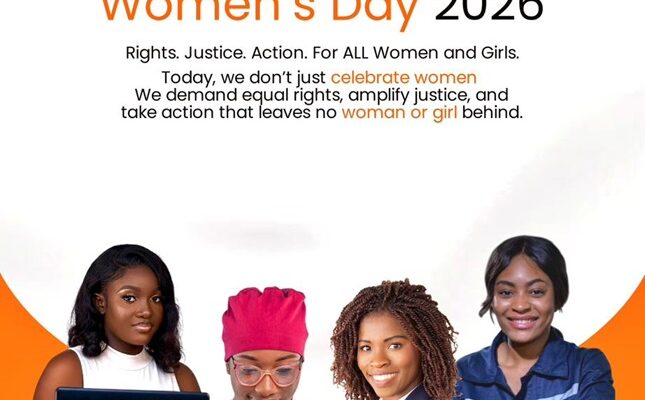

Every year on March 8, the world pauses to celebrate the achievements of women. Yet celebration alone cannot substitute for justice. As the world marks International Women’s Day 2026 under the theme “Rights. Justice. Action. For ALL Women and Girls,” and the campaign hashtag #GiveToGain, the moment calls for deep reflection on the realities women face in Nigeria. It is a call to understand that to build an equitable future, we must be willing to give—to dismantle old structures—in order to gain a more just and prosperous world.
Globally, progress toward gender equality has been significant but uneven. According to the World Bank’s Women, Business and the Law report, women enjoy only about 64 percent of the legal rights granted to men. While many countries have adopted laws promoting equality, structural barriers continue to limit women’s access to economic opportunities, leadership, and justice.
These inequalities affect access to opportunity itself. In many parts of the world, girls face obstacles in accessing quality education. Women encounter barriers in securing credit or owning land—a female farmer may be denied a loan because she cannot provide land title documents that custom reserves for men. Social norms continue to limit participation in leadership, and in some countries, widows can still be stripped of inheritance by their husband’s families. Such disparities demonstrate that legal recognition of rights does not automatically translate into equal opportunity.

This gap has fueled a global conversation about equity as a pathway to equality. While equality focuses on treating everyone the same, equity acknowledges that historical disadvantages require targeted interventions. Consider three people trying to see over a fence: equality gives them the same-sized box, so the tallest still sees best. Equity gives each person the box size they need. Policies expanding girls’ education or women’s leadership are therefore not privileges; they are corrective measures to address longstanding disparities.
Some critics argue such measures undermine merit. However, this overlooks structural barriers that have historically shaped the playing field. Access to political networks, financial resources, and mentorship has long favored men. Equity-focused policies do not replace merit; they correct systemic imbalances so merit can truly determine outcomes.
Countries with deliberate inclusion policies demonstrate the impact. Rwanda, rebuilding after the 1994 genocide, mandated that 30 percent of parliamentary seats be reserved for women. Today, women hold over 60 percent of seats—the world’s highest. Sweden and Spain, using party quotas, maintain women’s representation above 40 percent. These examples show how policy reforms can accelerate gender inclusion.
The Nigerian Reality: A Nation Held Back
Nigeria reflects these global patterns, but with a stark contrast between promise and reality. The constitution guarantees equal rights, and frameworks like the Violence Against Persons (Prohibition) Act promote inclusion. Yet lived experiences reveal persistent gaps.
The clearest example is political representation. Though women constitute nearly half the population, their legislative presence remains critically low. Only about 20 of 469 National Assembly members are women—roughly 4 to 5 percent. At state level, only about 54 of nearly 990 seats across 36 Houses of Assembly are held by women. Several state assemblies operate without a single female lawmaker, making decisions on health, education, and infrastructure without half the population’s perspectives.
This places Nigeria among countries with the lowest female parliamentary participation globally, far below the global average of over 27 percent. These figures reflect not a lack of capable women—from global leaders like Dr. Ngozi Okonjo-Iweala to countless entrepreneurs and community leaders— but structural barriers: exorbitant campaign costs, opaque party nominations, and social norms questioning women in leadership. The paucity of astute female examples in the Nigeria political arena is enough testament to the existential crises of gender inequality., especially on the ground that women occupy close to 51% of the entire population.
This context gives urgency to proposals like the Reserved Seats for Women Bill, which would introduce additional legislative seats specifically for women as a temporary corrective measure. Just as Rwanda created dedicated seats to jumpstart representation, Nigeria could use this mechanism to ensure institutions reflect the diversity they serve.
Justice Beyond the Ballot Box
Justice extends beyond representation to safety and dignity. In 2015, Nigeria enacted the Violence Against Persons (Prohibition) (VAPP) Act, criminalizing domestic abuse, sexual violence, and harmful practices like female genital mutilation. This was a landmark victory.
Yet the gap between law and lived experience remains vast. For a rural woman, the VAPP Act may as well not exist if the nearest police station is hours away, officers lack training to handle her case sensitively, or community elders pressure her to settle matters at home. Laws alone do not guarantee justice; they require effective institutions, public awareness, and accountability mechanisms. The law is the promise; implementation is the action.
Economic inclusion is the third pillar. Nigerian women drive local economies as farmers, traders, and entrepreneurs. Yet a thriving textile trader in Kano may be unable to access credit because she lacks land collateral traditionally held by men. A female professor may be paid less than male counterparts or passed over for leadership despite qualifications. These obstacles limit not only individual potential but Nigeria’s broader economic potential.
Closing these gaps is strategic investment. Global research consistently shows that when women gain equal access to resources, household welfare improves, communities become more resilient, and economies grow more sustainably.
The Path Forward: From Promise to Practice
The capacity of Nigerian women to lead is already evident. Their achievements highlight a simple truth: the challenge is not lack of capability but persistent lack of access.
Achieving meaningful equality requires intentional action. Government must invest in keeping girls in school, strengthen enforcement of laws like the VAPP Act, and ensure perpetrators face accountability. Political parties must reform nomination processes to be transparent and inclusive.
Financial institutions must create products serving women’s unique needs.
Empowering women should never be viewed as charity. It is a strategic imperative for building a resilient nation. As the world marks International Women’s Day 2026, the call for Rights. Justice. Action. must inspire more than celebration—it must ignite commitment to tangible change. Nigeria’s progress will depend on its willingness to move from promise to practice.
Equality may be the destination, but equity is the bridge. When Nigeria chooses to give—to invest intentionally in the rights, safety, and leadership of its women—the nation will gain a more inclusive, just, and prosperous future for all.
That is the true meaning of #GiveToGain
– Tosin Toluwaloju writes from Lokoja.