

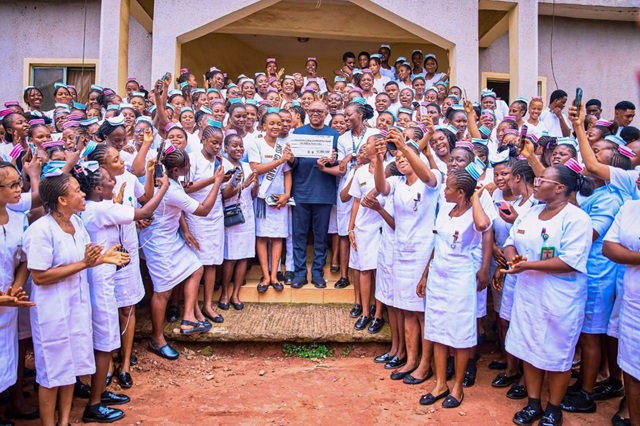
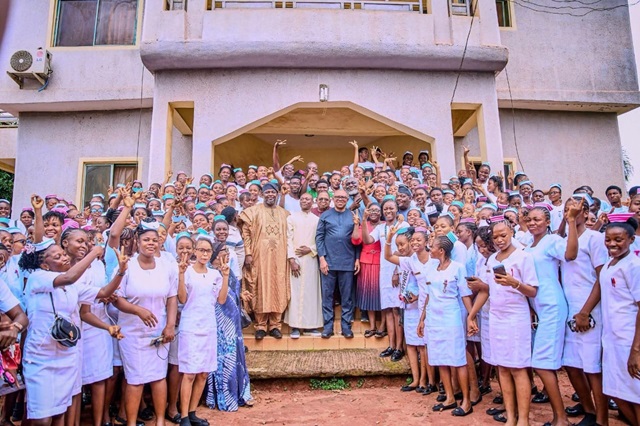
Three days ago, Peter Obi visited Grimard College of Nursing Sciences in Ayingba, Dekina Local Government Area of Kogi State, where an intervention made years earlier had helped avert an institutional crisis. The school had faced the threat of losing accreditation because students lacked a bus for clinical placements, an apparently modest deficiency with potentially devastating consequences for professional training.
Obi’s intervention helped provide the required bus, enabling the institution to retain its accreditation and continue training nurses and other healthcare professionals. The episode illustrates a neglected truth about development: institutions rarely collapse because of one spectacular failure. They deteriorate through accumulated deficiencies, administrative inertia and seemingly minor gaps that eventually become existential.
His latest visit carried that lesson further. Obi committed ₦10 million toward establishing a Skills Laboratory Centre, reaffirming his support for the institution’s management, faculty and students. The investment is significant not because of its headline value alone, but because practical competence is the indispensable bridge between professional education and the delivery of effective healthcare.

A nursing skills laboratory is therefore more than another building or item on an institutional inventory. It is where theoretical knowledge acquires clinical precision; where students rehearse procedures before confronting the vulnerabilities of real patients; and where professional judgement is cultivated through disciplined practice. In a country confronting persistent healthcare constraints, investments that strengthen the production of competent health professionals deserve to be treated as development infrastructure.

Nigeria’s deeper problem, however, is not simply a shortage of resources. It is a persistent failure to establish education and healthcare at the centre of national economic strategy. Governments routinely announce ambitious development programmes while schools, hospitals and professional training institutions continue to contend with inadequate facilities, equipment, personnel and funding.
This contradiction has serious economic consequences. Human capital is not an ornamental component of development; it is its productive core. A country cannot expect sustained productivity, technological advancement, healthier populations or international competitiveness while allowing its educational and healthcare institutions to operate below capacity.
The Ayingba example also exposes the limits of philanthropy. Private intervention can rescue an institution, close an infrastructure gap and demonstrate what targeted investment can achieve. But philanthropy cannot substitute for public policy. In a functioning developmental state, essential educational and healthcare infrastructure should not depend upon the extraordinary generosity of individuals to remain viable.
That distinction matters. The appropriate lesson from Obi’s intervention is not that government can abdicate its responsibilities because private citizens may eventually intervene. It is that strategic investment, whether public or private, produces greater social returns when it strengthens institutions rather than merely providing temporary relief.
The students at Grimard College now carry an obligation equal to the opportunity before them. Nursing offers possibilities far beyond the boundaries of Kogi State. Properly trained Nigerian nurses can serve across the country and compete in international healthcare systems, carrying with them not only professional credentials but the reputation of the institutions that trained them.
The wider lesson is unmistakable. Nigeria cannot build a modern economy while treating human capital as a secondary concern. Roads, bridges and power infrastructure matter, but so do the laboratories in which professionals are trained, the classrooms in which knowledge is transmitted and the hospitals in which that knowledge is ultimately converted into healthier lives.
Peter Obi’s ₦10 million commitment should therefore be viewed within this larger national calculus. Its enduring value will not be measured merely by the physical laboratory that emerges from it, but by the nurses who acquire competence there, the patients they eventually serve and the institutional standards they carry into a healthcare system desperately in need of renewal.
Nigeria’s renewal will require more than political declarations and development rhetoric. It will require a decisive reordering of priorities: investment before symbolism, competence before spectacle and human capacity before institutional vanity. The country’s greatest asset is not beneath its soil. It is the capacity of its people, and the quality of Nigeria’s future will ultimately depend on how seriously it chooses to invest in them.
– Inah Boniface Ocholi writes from Ayah – Igalamela/Odolu LGA, Kogi state.
08152094428 (SMS Only)