
By Yusuf, M.A
“O Allah, Owner of Sovereignty. You honour whom You will and You humble whom You will.” — Qur’an 3:26
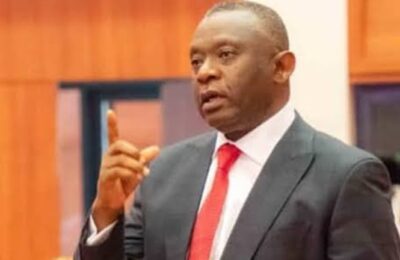
There are moments in Nigeria’s governance cycle that force even the most seasoned citizens to confront a familiar truth: authority in this country is not an institution; it is a motion. Power does not simply transition here; it swivels, flips, and realigns with a speed that mocks any expectation of stability. The nomination of General Christopher Gwabin Musa as Minister of Defence is one such moment—dramatic enough to compel reflection, yet ordinary enough within the Nigerian system to appear unsurprising.

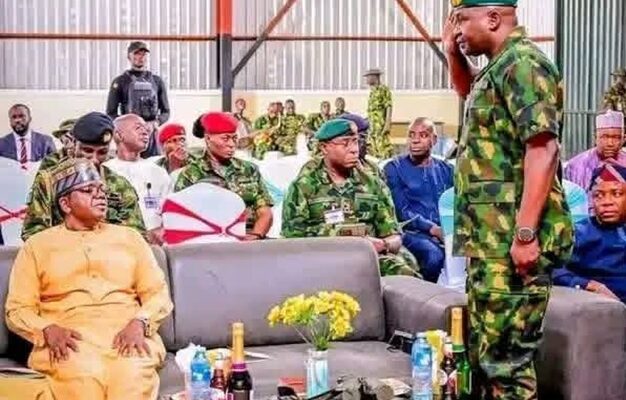
Only weeks ago, Musa stood as the nation’s Chief of Defence Staff—the constitutional summit of military command. In that role, protocol demanded that he salute the Minister of State for Defence, Bello Matawalle. The salute symbolised more than rank; it was the military acknowledging the civilian authority it is bound to obey under a constitutional democracy.
Then, in one of the sudden rearrangements for which Nigeria is famous, the resignation of Minister Badaru altered the entire architecture. With a single nomination, the President recalled Musa—not to a quiet desk, not to an advisory corridor, but to the apex of political authority in Defence. The result is a complete inversion: the man who saluted Matawalle only weeks ago returns as his superior. In a stable institutional environment, such a reversal would be extraordinary. In Nigeria, it is almost routine.
This is the deeper problem. Our public institutions are not designed to outlast individuals; they are designed to accommodate them. Hierarchy functions here as a costume—worn today, discarded tomorrow—depending on the convenience of political timing. What should be an organised chain of command dissolves into a sequence of improvisations.
To reduce this development to personalities is to misunderstand the crisis. Nigeria has long operated a governance model in which offices change frequently, yet the policies attached to them rarely evolve. Appointments give an appearance of movement, but the machinery of public administration remains stagnant. It is this mismatch—between theatrical turnover and institutional inertia—that has produced a country where insecurity is not merely a challenge but a permanent feature of political life.
General Musa’s record as CDS is not the issue here. He served during a period when Nigeria’s security matrix was scattered across multiple commands, each pulling in different directions. His return now raises critical questions about intention: Is this a realignment of strategy or an instinctive political reflex? Is it an attempt at institutional coherence, or simply another reshuffling of familiar faces to mask deeper dysfunction?
Nigeria’s citizens immediately understood the symbolism. One widely circulated comment captured it: “A few weeks ago, Musa saluted Matawalle. Today he returns as Defence Minister—now senior to the man he saluted.” Behind the humour lies a more serious awareness: the Nigerian state often behaves like an improvisational stage in which roles shift faster than responsibilities.
What the country needs—what it has always needed—is not rapid rotation of personnel but stability of policy. Nigeria requires a Defence Ministry that operates on clarity, long-term planning, and institutional memory. It requires leaders who are not merely placed into office but equipped to reform the architecture they inherit. If Musa’s return is to be meaningful, it must signal a departure from the habit of recycling authority without addressing the structural rot beneath it.
This moment resonates because it exposes the illusion surrounding power in Nigeria. Authority here is rarely anchored in predictability. It is shaped by circumstance, timing and the convenience of those who wield it. That is why the system struggles to produce continuity. That is why reforms collapse midway. That is why insecurity thrives: the state is always changing actors but rarely changing the script.
Power turning on its axis is not the issue. It always has. The real danger is that Nigeria continues to confuse rotation with reform, motion with progress, and theatrics with governance. The actors change, the choreography changes, the applause changes, but the national condition remains unmoved.
This nomination, like many before it, leaves the country confronting an uncomfortable conclusion: hierarchy in Nigeria is a temporary garment worn for effect. It dazzles in photographs, conveys momentary authority, and then shifts to the next occupant. Until we build institutions that survive the people who occupy them—institutions anchored in discipline, consistency, and accountability—the performance will remain unchanged, even when the actors trade places overnight.
– Yusuf, M.A., PhD is a lecturer, researcher, and public policy analyst, and a key strategist with the Kogi Equity Alliance (KEA). He writes on governance, equity, and democratic development.
Email: moooahmad@yahoo.com
Phone: +2348023856226