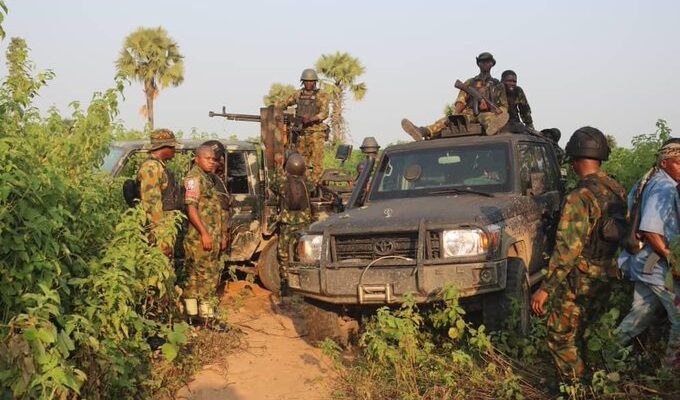

Nigeria’s battlefields are littered with tactical victories. Insurgent commanders fall. Terror camps burn. Armed networks fracture. Yet the violence regenerates with relentless speed, mutating into new forms, new alliances, and new threats.
What the country now confronts is no longer a single insurgency, but an evolving security ecosystem where jihadist movements, criminal syndicates, and armed banditry increasingly converge. Extremism fuses with organised crime. Ideology blends with predation. Groups that once operated separately now form hybrid structures that are harder to defeat and easier to reproduce.
Military force remains essential. No sovereign state can abandon its duty to protect its citizens. Nigeria’s armed forces have made real sacrifices and achieved real gains. But experience shows that force alone cannot deliver lasting security. Armed groups are replenished by poverty, ungoverned spaces, porous borders, weak intelligence systems, and economic exclusion. Each battlefield success fades because the conditions that produce violence remain intact.

History offers a warning. Earlier religious uprisings evolved into Boko Haram. Boko Haram now converges with criminal banditry. Violence does not disappear. It transforms.
Dialogue, often dismissed as surrender, deserves a more disciplined interpretation. Strategic engagement is not appeasement. It is not moral compromise. It is a tool of statecraft. When used selectively, under strict conditions, and alongside sustained military pressure, dialogue becomes an instrument for intelligence extraction, factional division, and de escalation.
This approach is not theoretical. Negotiated channels have previously secured hostage releases and humanitarian access, demonstrating that communication can sometimes achieve outcomes that force cannot.
But dialogue without discipline is dangerous. There must be no blanket amnesty for mass violence, no ransom economy, no political legitimisation of terror networks, and no immunity for crimes against humanity.
The answer is not force or dialogue. It is fusion.
Relentless military operations. Intelligence led targeting. Secured borders. Economic reconstruction of vulnerable regions. Community security architecture. Selective dialogue used as a surgical instrument, not a peace illusion.
Nigeria does not face a war of bullets alone. It faces a war of governance, institutions, legitimacy, and opportunity.
Dialogue is not surrender. It is leverage. And when combined with force, intelligence, and reform, it becomes not a concession to terror, but a weapon against it.
– Inah Boniface Ocholi writes from Ayah – Igalamela/Odolu LGA, Kogi state.
08152094428 (SMS Only)