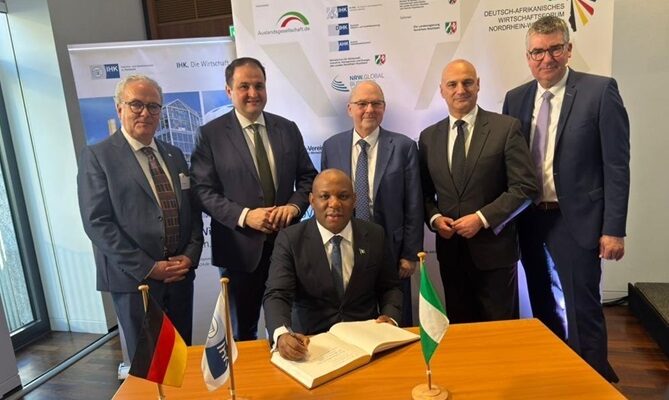

Early this month March, Nigeria’s Honourable Minister of Steel Development, Prince Shuaibu Abubakar Audu, undertook a pivotal trip to Dortmund, Germany, where he delivered a keynote address at the Nigeria–German Economic Forum. The trip — part of ongoing efforts by the Federal Government under President Bola Ahmed Tinubu’s Renewed Hope Agenda — marked a significant step in strengthening Nigeria’s industrial engagement with Europe and unlocking opportunities for investment in the country’s steel, metals and broader industrial value chains.
The minister’s speech resonated with themes of partnership, industrial revitalisation, and economic diversification. Addressing an audience of German business leaders, policymakers, and investors, Prince Audu portrayed Nigeria not merely as a source of raw materials, but as a strategic market with massive demand for steel products, industrial infrastructure and value-added manufacturing. His address underscored the vast potential of Nigeria’s steel industry one that, with the right investments and collaboration, could become a linchpin of African industrial development.
For decades, Nigeria’s steel industry has struggled with underperformance, out dated facilities, and heavy reliance on imported steel — with annual imports reportedly valued at roughly $4 billion to meet local demand in absence of robust domestic production. This situation exerts serious pressure on foreign exchange reserves and undermines industrial competitiveness.

In his keynote, Prince Shuaibu Abubakar Audu articulated a new vision: one in which Nigeria advances from being a net importer to a value-adding industrial hub capable of producing steel for local use and export. He highlighted that Nigeria’s large population (approaching 250 million), youthful workforce, and untapped mineral wealth — including iron ore, limestone, manganese and other inputs — provide a strong foundation for industrial expansion.
This framing resonates with Nigeria’s broader economic strategy under the Renewed Hope Agenda to diversify the economy away from oil, boost manufacturing, create jobs, and attract sustainable foreign direct investment (FDI). The German forum, held in one of Europe’s industrial heartlands, was strategically chosen to capture the attention of global investors with the technology, capital and market access needed for such transformation.
Germany is Europe’s largest economy and a global leader in engineering, manufacturing, and industrial technology. Its steel industry powered by high-end steel producers, advanced metallurgy, and strong industrial clusters offers precise expertise that aligns with Nigeria’s ambitions.
Germany’s expertise in steel processing, plant automation, and sustainable industrial production can help modernise Nigeria’s steel plants and supply chains. The minister’s presence in Germany reinforces Nigeria’s willingness to collaborate on technology transfer partnerships, joint ventures, and capacity-building initiatives.
Prince Audu’s message emphasised that Nigeria’s steel market represents a potential $10 billion annual market, reflecting strong domestic demand. This figure is a powerful signal to European investors that the Nigerian market is not speculative but has measurable demand and growth potential.
Attracting German and EU investment capital could help finance upgrades to legacy infrastructure like the Ajaokuta Steel Complex, galvanising plants, and downstream processing facilities — spurring economic activity along entire value chains.
The trip enhances diplomatic ties between Nigeria and Europe. Strong relations with Germany — a gateway to broader EU markets create avenues for Nigeria to access preferential trade arrangements, technology collaborations, and sustainable development financing.
Prince Audu’s address in Dortmund centred on several core themes:
Audu highlighted Nigeria’s natural resource endowments and demographic advantages, offering a compelling narrative to investors looking for untapped markets with strong fundamentals.
Rather than ad-hoc investment, the minister called for long-term and credible partnerships — especially with European firms willing to commit to local value addition, skills development and infrastructure expansion. This framing is crucial; it shifts the narrative from transactional investments to integrated industrial cooperation.
The keynote underscored Nigeria’s efforts to improve its investment climate. While specific policy reforms were not exhaustively outlined in the speech, they align with ongoing federal plans to streamline regulations, enhance ease of doing business, and protect investor interests under the Renewed Hope Agenda creating a more predictable and competitive environment for foreign investors.
The minister’s visit holds potential advantages for Nigeria across multiple dimensions:
The trip serves as an invaluable marketing and networking platform, helping position Nigeria as an attractive destination for foreign investors in steel, mining, manufacturing, power, and logistics.
By putting Nigeria’s industrial agenda on the radar of German corporations, funds, and industrial consortia, the speech enhances the prospect of direct investment flows and collaborative ventures.
A revitalised steel industry would generate thousands of jobs — both directly in steel plants and indirectly in logistics, construction, engineering, and services. Partnerships with German firms also promise skills transfer, apprenticeships, and workforce development critical for Nigeria’s young population and future competitiveness.
Attracting investment into steel production contributes to a virtuous cycle: improved local manufacturing reduces import dependency, conserves foreign exchange, and strengthens industrial ecosystems from construction to automotive, energy, and infrastructure projects.
Nigeria could leverage its steel production capabilities to serve West African markets and beyond, positioning itself as a regional export hub — a role that aligns with economic integration under the African Continental Free Trade Area (AfCFTA).
The engagement in Germany opens doors to multilateral cooperation in renewable energy, industrial technology, and training programs. Germany’s focus on sustainable industrial development can dovetail with Nigeria’s ambitions to industrialise responsibly and reduce environmental impacts.
The key challenge now is transforming the momentum of the minister’s trip into tangible outcomes. This will require follow-up with German business delegations, memoranda of understanding (MoUs), and joint implementation frameworks to translate interest into committed projects. Nigerian policymakers, including the Ministry of Steel Development, will need to actively structure investment incentives, regulatory certainty, and project pipelines to match the expectations of international firms.
If managed well, this engagement could herald a new industrial chapter for Nigeria, helping shift the narrative from chronic under-capacity to strategic industrial resurgence — powered by partnership, innovation and strong global links.
In conclusion, the trip of the Minister of Steel Development to Germany and his keynote address represents more than a diplomatic engagement it embodies Nigeria’s aspirations for industrial transformation and economic diversification. By articulating the country’s strengths, inviting strategic investment, and positioning Nigeria within European industrial networks, the minister has laid groundwork that — with prudent follow-through — could yield long-term benefits for Nigeria’s economy and people.
– Musa Wada, a public affairs analyst, sent this piece from Abuja.