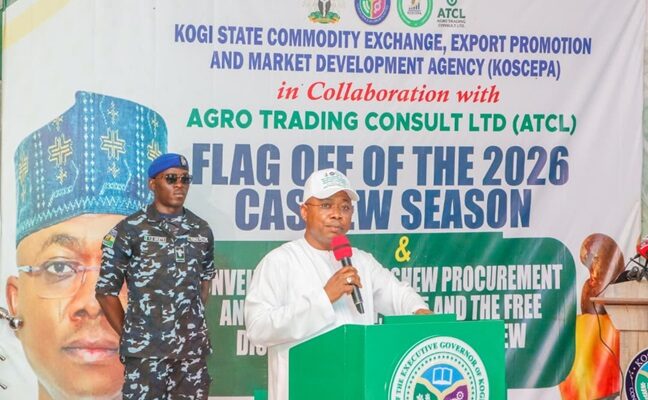

The National Cashew Association of Nigeria (NCAN) has commended Kogi State Governor, Alhaji ahmed Usman Ododo, for implementing a pricing policy, which according to them, stabilized the market and pushed the commodity’s value to about N1.8 million per tonne.
Speaking in an interview on Friday, NCAN National President, Dr Ojo Ajanaku, described the governor’s action as a bold and patriotic step that has protected farmers from years of price manipulation.
Ajanaku said the Kogi State government’s strict enforcement of its cashew procurement framework has prevented foreign buyers from purchasing the produce directly at the farm gate, a move he noted has helped maintain fair pricing.

According to him, the state adopted the Kogi State Cashew Procurement Policy, which aligns with an earlier directive by the Federal Executive Council (FEC) that restricts foreign traders from direct farm-gate purchases.
He explained that the development has brought relief to farmers who, for years, faced sharp price drops driven by external buyers.
“We have been in this sector for a long time. Personally, I have spent more than three decades in the cashew industry,” Ajanaku said.
He recalled that over the past decade, foreign buyers often influenced the market during the harvesting season, particularly around the Salah festivities, when many farmers were eager to sell their produce quickly for cash.
“They usually take advantage of farmers’ situation to control prices and deliberately push them down, which has been unfair to producers,” he said.
Ajanaku noted that with the current policy in place, cashew prices have remained stable at about N1.8 million per tonne, a development he described as unprecedented in recent years.
He added that in the past, prices could suddenly fall to between N300,000 and N500,000 per tonne due to coordinated actions by foreign buyers.
The NCAN president also said the collaboration between the Kogi State government and the association has helped ensure farmers receive better returns for their produce.
He pointed out that Kogi is among the leading cashew-producing states in Nigeria, and the government’s intervention has played a major role in strengthening the sector.
Ajanaku explained that the policy effectively barred foreign traders from dealing directly with farmers, limiting their ability to influence prices.
“For the first time in about 10 years, the price did not crash because those buyers could no longer dictate the market,” he said.
He added that the situation in Kogi had a wider impact across Nigeria’s cashew industry, given the state’s significant contribution to national production.
According to him, the stability in pricing could also support the value of the naira, stressing that strong political backing for farmers and the agricultural sector would help strengthen the country’s economy.
He argued that unfair trading practices by some foreign buyers undermine local producers and, ultimately, the nation’s currency.
Ajanaku urged government officials to pay closer attention to the broader economic implications of such market dynamics, noting that protecting local agricultural value chains is critical to Nigeria’s economic resilience.