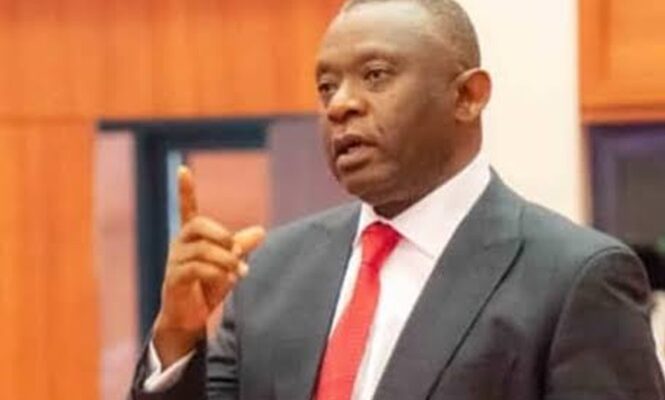

In the theatre of politics, noise is easy. It requires little more than slogans, spectacles and seasonal outrage. But in the arena of governance, results are the only currency that matters. When the applause fades and the posters come down, what remains is the record—solid, measurable, and lived by the people.
It is against this standard that Distinguished Senator Sunday Steve Karimi must be judged. And it is precisely why he stands apart.
Nigeria has watched leaders come and go, many arriving with grand declarations and departing with elaborate explanations. Yet, from Kogi West to the red chamber in Abuja, Senator Karimi has charted a different course. He is not merely a representative occupying a seat; he is a pathfinder redefining what that seat can produce.

For Senator Karimi, leadership is not performance art. It is a debt of service. While others perfect the language of excuses—why things cannot be done, why the moment is not right, why constraints are insurmountable—he has quietly focused on delivery. In governance, proof is louder than promises, and his work has consistently supplied the evidence.
This is the essence of what many now describe as the “architecture of results.” It is leadership built deliberately, brick by brick, policy by policy, intervention by intervention. It is not accidental, and it is certainly not cosmetic.
One of the defining features of Senator Karimi’s public life is his preference for action over rhetoric. He does not merely announce progress; he clears the path for it. Projects, advocacy, and legislative engagements under his watch are not abstractions. They are footprints—visible markers that others now follow. In an environment where talk often substitutes for work, this distinction matters.
Equally important is the Okun spirit he brings to leadership. Senator Karimi is a product of his people’s resilience, integrity and quiet determination. That heritage has shaped his approach to public service. He carries it with him into the hallowed chambers of the Senate, not as a slogan, but as a compass. It informs his choices, grounds his priorities, and keeps him accountable to those who sent him there.
Perhaps most compelling is what many in Kogi West have come to see as his guarantee of delivery. When Senator Karimi commits, the conversation ends and execution begins. His word functions as a bond—one reinforced by consistency rather than ceremony. In a political culture fatigued by unfulfilled pledges, such reliability has become a rare asset.
This is not leadership by excitement. It does not depend on viral moments or manufactured drama. It is leadership by example—calm, focused, and rooted in the belief that governance is about producing outcomes, not headlines. It reflects a reasoned conviction that the best hand for the job is often the one already producing the harvest.
Support for Senator Karimi, therefore, is not built on sentiment alone. It is anchored in experience. To his friends, associates, and the good people of Kogi West, the choice has increasingly become a practical one. This is not about rallying behind a name; it is about sustaining a legacy of excellence that has already proven its worth.
As conversations inevitably turn toward the future—toward 2027 and beyond—the question before the electorate is straightforward: do we trade tested capacity for uncertain promises, or do we consolidate on a standard that works?
By any fair assessment, Senator Sunday Steve Karimi has set that standard. In an era desperate for results, he remains incomparable—not because he says so, but because the record does.
– Ibrahim Ahmad writes from Lokoja.