

By Stephen Adeleye.
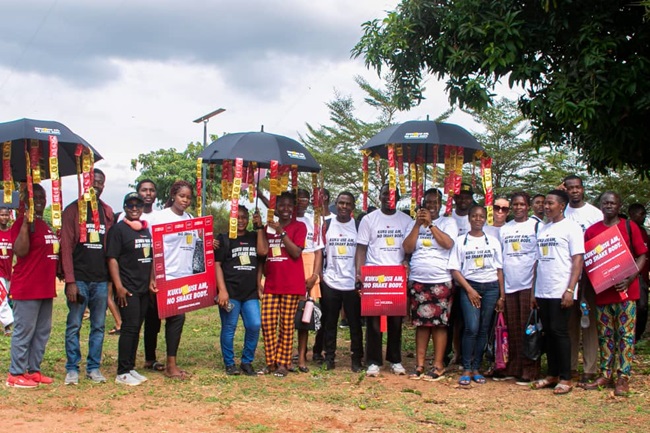
In a bold move to curb new HIV infections and reinforce prevention awareness, the AIDS Healthcare Foundation (AHF) Nigeria, in collaboration with the Anambra State AIDS Control Agency and other key stakeholders, held a road walk in Awka, Anambra State, to commemorate the 2026 International Condom Day, marked annually on February 13.
The advocacy walk, which drew health workers, civil society groups, and government partners, served as both a public sensitization campaign and a renewed call for responsible sexual behavior in the state.

Speaking during the event, the Senior Advocacy and Marketing Manager of AHF Nigeria, Steve Aborishade, said the initiative forms part of AHF’s global efforts to prevent new HIV infections.
“AHF is the largest global AIDS organization. We are in 47 countries, with over 2.7 million persons on our program receiving care. In Africa, we operate in 14 countries, and Nigeria is one of them. Anambra is one of the states where we work,” he said.
According to him, International Condom Day is a project initiated by AHF globally to promote preventive measures against HIV and other sexually transmitted infections (STIs).
“We started it because there is a need for people to protect themselves from HIV infection and other STIs. The condom has proven to be the most effective and cheapest method of preventing HIV/AIDS,” Aborishade stated.
He explained that the road walk was aimed at popularizing condom use and reminding residents that preventing infection eliminates the need for treatment.
“The only way we can end AIDS in our country and continent is by stopping new infections. Today, we are sharing AHF-branded condoms to thousands of people in Anambra. The key message is: prevent HIV, stay healthy, and live your life. HIV is preventable, and the biggest route of transmission remains unprotected sex,” he added.
Also speaking, the AHF State Coordinator in Anambra, Vivian Sunday, emphasized the importance of partnership in the fight against HIV. “In all the states where we operate, we work in partnership because we cannot fight this battle alone.
“We collaborate with the Anambra State AIDS Control Agency (ANTSACA), the Anambra State AIDS and STI Prevention Unit (SASCAP), the Network of People Living with HIV and AIDS (NEPWHAN), Achieving Health Nigeria Initiative (AHNI), the Police Action Committee on AIDS (PACA), and other community-based organizations.
She noted that advocacy remains central to AHF’s strategy, especially in a state with notable HIV prevalence. “Anambra State has an HIV prevalence rate of 2.4 percent according to the NAIIS 2018 survey, making it the highest in the Southeast. With this data, there is a need to educate the public on living responsibly,” she said.
Sunday stressed that while abstinence remains the best preventive option and faithfulness to one partner comes second, correct and consistent condom use remains critical. “We are not promoting promiscuity. What we are saying is that if you cannot abstain and cannot be faithful to one partner, please use condoms correctly and consistently.
The AHF State Coordinator insisted that condom use shows responsibility for one’s health and that of his partner. “Condoms offer dual protection — against sexually transmitted infections, including HIV, and against unwanted pregnancies,” she concluded.
On his part, John Bosco Ementa, Project Manager of the Anambra State AIDS Control Agency, described the event as part of broader efforts to achieve epidemic control in the state.
“As the coordinating agency for HIV multisectoral response in Anambra State, we oversee prevention, treatment, care, and support services. AHF is one of our key partners providing free HIV treatment, testing, condoms, and other prevention tools across facilities in the state,” he said.
Ementa reiterated that International Condom Day provides an opportunity to re-emphasize condom use as a tested and trusted prevention tool.
“Research has shown that consistent and correct use of condoms prevents HIV transmission. Prevention is better than cure. The cost of treatment outweighs prevention efforts. We want fewer people to contract HIV because if you do not contract it, you will not rely on antiretroviral drugs,” he noted.
He added that condoms are available in pharmacies, health facilities, and through patent medicine vendors, with free access at designated facilities. “Our goal is to reduce new infections, achieve viral suppression among those already on treatment, and ultimately attain epidemic control in Anambra State in line with global targets”.
The road walk concluded with the distribution of free condoms and educational materials, reinforcing the central message of the day: live responsibly, prevent HIV, and take charge of your health.