
By Adams Yusuf
Since Nigeria’s return to democracy in 1999, a peculiar orthodoxy has governed political representation in Kogi State. Senators elected to represent Kogi East focused exclusively on Kogi East. Those from Kogi West limited interventions to Kogi West. Kogi Central senators addressed only Kogi Central challenges. This unwritten covenant—that senatorial representation terminates at district boundaries—remained unquestioned for over two decades. Until Distinguished Senator Sunday Steve Karimi DSSK shattered the precedent entirely.
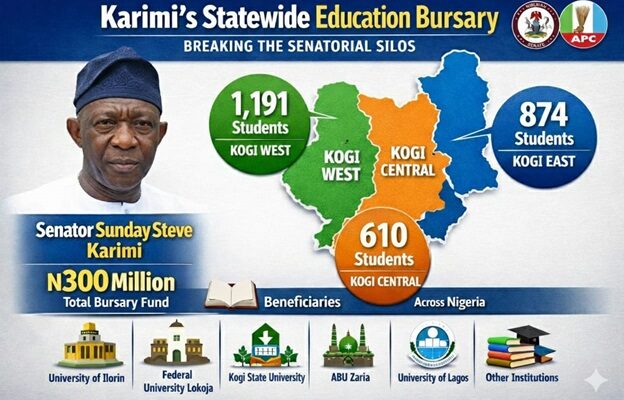
His N300 million bursary program extends across all three senatorial districts, supporting 2,675 students regardless of which senator represents their home constituency. For the first time in Kogi State’s democratic history, governance dividends have reached all Kogites through a single senator’s initiative. This represents not incremental progress but categorical transformation of how political leadership conceives its obligations.

The historical context renders this moment profoundly significant. For a quarter-century, Kogi’s senatorial districts operated as separate political fiefdoms. Resources flowed vertically—from federal allocation through senators to immediate constituents—but never horizontally across district lines. A student from Kogi East facing educational financing gaps would never consider approaching the Kogi West senator for support. The boundaries were understood, respected, and reinforced through every electoral cycle.
This siloed architecture created predictable inequities. Districts with politically active or resource-rich representatives experienced greater development interventions. Those with less effective senators endured comparative neglect. Students, families, and communities suffered or prospered based largely on the geographic accident of senatorial district residence. The system perpetuated disparities while constraining the developmental impact any single senator could achieve.
Senator Karimi’s statewide approach renders these silos intellectually and practically obsolete. Supporting 1,191 beneficiaries from Kogi West, 874 from Kogi East, and 610 from Kogi Central, his intervention reaches students at University of Ilorin, Federal University Lokoja, Ahmadu Bello University, University of Lagos, and institutions across Nigeria, studying disciplines from Medicine and Engineering to Agriculture and Education. Geography has ceased determining access to senatorial support.
The philosophical foundation deserves examination. Senator Sunday Karimi evidently operates from the premise that education constitutes society’s bedrock—not merely Kogi West society but Kogi State society and ultimately Nigerian society. Educational investment cannot be geographically confined because its benefits radiate outward and compound across generations. A medical student from Kogi East who completes training through this bursary will serve patients statewide and nationally. An engineering graduate from Kogi Central will design infrastructure benefiting all Nigerians. A teacher from Kogi West will educate the next generation regardless of their geographic origins.
This understanding—that educational investment transcends political boundaries precisely because educated citizens serve collective futures—explains why Senator Karimi structured his program statewide rather than limiting it to immediate constituents. He is investing in human capital that will drive Kogi State’s development for decades, recognizing that human capital acknowledges no senatorial demarcations.
The published transparency amplifies this intervention’s historic character. Senator Karimi didn’t merely announce statewide support; he published complete beneficiary lists with names, institutions, programs of study, and award amounts ranging from N100,000 to N500,000. This documentation enables verification across all three senatorial districts. Communities in Kogi East can confirm their young people appear on these lists. Families in Kogi Central can verify their students received promised support. Unprecedented accountability accompanies unprecedented geographic reach.
The contrast with traditional senatorial practice becomes instructive. Previous senators might announce constituency projects within their districts—boreholes commissioned, schools renovated, roads graded. Senator Karimi has published spreadsheets with hundreds of names spanning three districts, creating distributed verification infrastructure that operates continuously as students and families confirm receipt or report discrepancies. The accountability mechanism is as revolutionary as the statewide scope.
Political implications merit acknowledgment without cynicism. Senator Karimi is building recognition and goodwill across all of Kogi State, positioning himself distinctively for statewide office while simultaneously raising uncomfortable questions for senatorial colleagues: If a Kogi West senator can support students statewide, why haven’t Kogi East and Kogi Central senators reciprocated? The competitive pressure this generates may prove as transformative as the direct educational impact.
Yet beyond political calculations operates genuine development philosophy. Education as society’s bedrock requires systematic investment prioritizing talent over geography, potential over political affiliation, merit over senatorial boundaries. Senator Karimi’s program operationalizes this philosophy at meaningful scale. The N300 million investment represents serious commitment to comprehensive human capital development that will yield returns for decades.
The testimonials emerging carry particular weight because they originate from across all three districts. Atokolo Onalo from Kogi East expressed gratitude for his daughter’s support at Ahmadu Bello University, noting this represents “the first major support from a political cycle in Kogi State” his family has received. That phrase—first major support from any political cycle—articulates powerfully what leadership typically delivers versus what Senator Karimi is delivering presently.
For 25 years, Kogi State’s democratic practice reinforced senatorial silos that constrained development impact while perpetuating inequities. Senator Karimi has demonstrated these boundaries represent choices, not inevitabilities. A senator can invest statewide. Resources can flow horizontally. Education can be prioritized as collective good rather than narrow political patronage confined by artificial geographic constraints.
The historic precedent is established. Kogi State has witnessed what statewide senatorial vision produces—2,675 students across three districts receiving documented support with published transparency. The question confronting future political leaders is elemental: Will they match this standard or retreat to the limited district-focused approach characterizing the past quarter-century?
Senator Karimi believes education constitutes society’s bedrock. He has validated that conviction with N300 million invested statewide, complete transparency, and recognition that educated young people will drive collective progress regardless of which senatorial district raised them. This is statesmanship transcending conventional political practice. This is what becomes possible when intellectual clarity about development meets political courage to execute at scale. History is watching. Kogi State is transformed.
– Adams Yusuf writes from Lokoja.