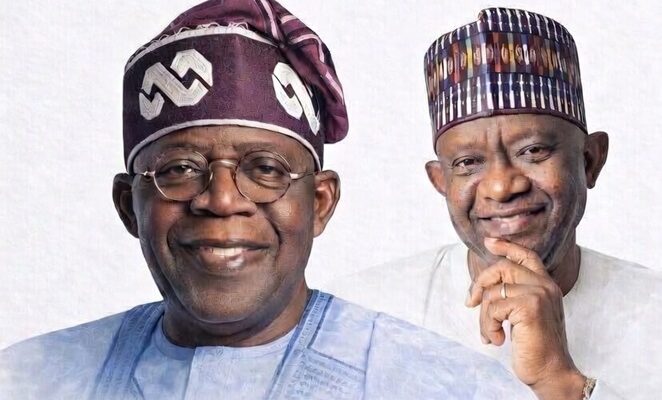

By Adams Yusuf
In Nigerian politics, most leaders are defined by the boundaries they inherit. A few are defined by the boundaries they dissolve.
Distinguished Senator Sunday Steve Karimi belongs to the latter category.

At a time when representation is often reduced to geography, his approach has introduced a more sophisticated proposition: that power is secured not merely by holding a district, but by building trust beyond it. This is not rhetoric. It is a method. And in Kogi State today, it is producing measurable results.
Senator Karimi’s record in Kogi West is established. What is now reshaping the political landscape is how that record has been deliberately extended into Kogi East, transforming what would ordinarily be separate political spaces into a shared field of engagement.
The evidence is no longer abstract. It is documented.
Through a bursary programme exceeding ₦400 million, thousands of students have been supported across Kogi State, cutting across Kogi West, Central and East. Within this broader framework, verified beneficiaries from Kogi East provide clear evidence of deliberate cross-regional inclusion. Records indicate a distribution across the entirety of Kogi East, covering Ankpa, Dekina, Idah, Ibaji, Bassa, Omala and Olamaboro Local Government Areas, underscoring a structured and geographically inclusive intervention.
Names such as Loveth Williams (Ankpa), Joseph Sunday (Omala), Zainab Saliu (Bassa), Attah Omeye (Ibaji), and Suleiman Atta (Idah)—among many others—are not symbolic mentions. They represent a structured intervention that cut across the breadth of Kogi East.
This is not outreach. It is an integration.
That integration was reinforced on an even larger scale during the Ramadan and Lenten seasons.
In collaboration with the Kogi Progressive Stakeholders Forum, Senator Karimi facilitated the distribution of approximately ₦300 million worth of food items and palliatives across Kogi State, with substantial penetration across all Local Government Areas of Kogi East.
This intervention was not selective. It was comprehensive.
Muslim and Christian communities were reached without distinction. Vulnerable households, grassroots networks and community stakeholders were engaged within a coordinated framework. What emerged was not simply relief distribution, but a demonstration of political inclusiveness at scale.
For a Senator from Kogi West, this scale of cross-regional intervention is historically uncommon.
It signals a shift, from representation as entitlement to leadership as responsibility.
And politics responds to such shifts.
Across Kogi East, what began as engagement is increasingly interpreted as alignment. Trust is no longer tentative. It is being structured. The distance between districts is narrowing, not through speeches, but through sustained presence and shared benefit.
This is how serious political coalitions are built.
Not through declarations, but through delivery.
Kogi’s electoral arithmetic is clear: Kogi East holds 9 Local Government Areas, West 7, and Central 5. No candidate secures statewide legitimacy without cross-regional alignment. Senator Sunday Karimi is not approaching this reality theoretically. He is operationalising it.
His Kabba Day remarks captured this strategic clarity:
“Let me tell you, you elected me to represent you. We are reaching out to our people in the East and we are working together. I can tell you confidently: the people in the East, they are ready to work with us.
The ball is in our court. Power is never served; you take power.”
This is not an aspirational language. It is an organisational language.
What is emerging is a coalition built on evidence, not expectation.
It is within this context that the emerging alignment with the national direction of the All Progressives Congress under Asiwaju Bola Ahmed Tinubu must be understood, not as political speculation, but as structural convergence. A national anchor at the center, and a unifying, cross-regional figure within the state.
It also reflects a commitment to party cohesion, institutional continuity and disciplined political growth.
For Kogi East, the decision is no longer theoretical. It is empirical.
Leadership that arrives before elections carries more weight than promises that arrive during them.
Senator Karimi has not merely extended his reach. He has redefined it.
Kogi is witnessing the emergence of a new political grammar, one where power is not negotiated from isolation, but assembled through inclusion.
If 2027 is to be decided by structure rather than noise, by alignment rather than division, then the trajectory is already visible.
Kogi East is not being persuaded.
It is responding.
And in politics, that distinction is decisive.
Ultimately, leadership that unites constituencies at the state level strengthens cohesion at the national level. That is the broader significance of what is unfolding in Kogi today.
– Adams Yusuf writes from Lokoja.