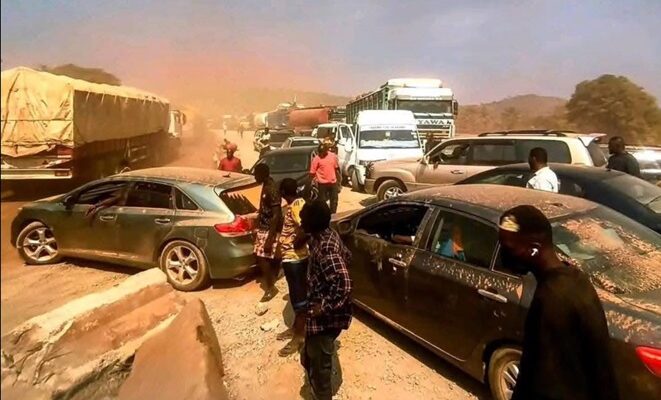

The persistent traffic gridlock along the Abuja–Lokoja corridor has moved far beyond daily inconvenience. It has become a serious economic, social, and security concern. A journey that was once predictable is now an ordeal, frustrating commuters, exposing travellers to risk, inflating the cost of goods, and weakening regional economic activity. This situation points to a clear truth: road transport alone can no longer sustain the growing movement of people and goods between the Federal Capital Territory and Kogi State.
The Abuja–Lokoja road remains one of Nigeria’s most strategic transport corridors. It links the North and the South, connects Abuja to several states, and serves as a major route for food supplies, fuel distribution, and manufactured goods. Over time, population growth, rising vehicle numbers, recurring road repairs, accidents, security checkpoints, and weak traffic coordination have pushed the corridor beyond its capacity. Gridlocks lasting several hours, and sometimes days, are no longer unusual. They have become part of everyday travel on the route.
This reality demands more than routine road repairs or lane expansion. While such efforts remain important, they no longer address the scale of the problem. Nigeria must begin to rethink mobility along this corridor by investing in alternative transport systems that can reduce pressure on the highway while improving safety, efficiency, and economic performance.
Rail transport offers one of the most effective long-term responses. A standard rail or light rail connection between Abuja and Lokoja would remove a significant share of passenger and freight traffic from the road. Trains move large numbers of people and heavy cargo more efficiently and with fewer accidents, while offering lower operating costs over time. Beyond easing congestion, a rail link would stimulate economic activity along the corridor, create jobs, and encourage the growth of satellite communities. For agriculture and trade, freight rail would enable food produce from the Middle Belt and the North to reach Abuja and southern markets faster, reducing transport costs and post-harvest losses.
Urban mobility must also be part of the solution. A tram or light rail system within Abuja, extending to nearby satellite towns, would reduce the number of private vehicles and commercial buses feeding into major highways. When commuters have reliable and affordable alternatives, dependence on private cars naturally declines, easing pressure on intercity roads and improving overall traffic flow.
Lokoja’s location at the confluence of the Rivers Niger and Benue presents another opportunity that remains largely underused. With proper investment in jetties, modern vessels, safety infrastructure, and regulation, inland water transport can serve as a practical option for both passengers and cargo. Cargo barges, in particular, can move heavy goods that currently overload roads, accelerate their deterioration, and contribute to gridlock. Water transport also offers a cost-effective and environmentally friendly complement to road and rail systems.
For these alternatives to work, transport development must be integrated. Road, rail, and water transport should function as a connected system rather than isolated projects. This requires coordinated planning across federal and state governments, supported by clear policy direction. Public–private partnerships will be critical in mobilising investment, improving efficiency, and reducing the financial burden on public funds.
The Abuja–Lokoja gridlock is a warning that Nigeria’s current transport model is no longer sustainable. Continued reliance on a single highway exposes the country to economic losses, security risks, and social strain. Investing in rail, tram, and water transport is not an indulgence. It is a necessity. If Nigeria is serious about modern infrastructure, regional integration, and long-term economic growth, the Abuja–Lokoja corridor should become a pilot for a truly multimodal transport system. The cost of inaction is already evident, and the time to act is now.
– Seyi Babaeko,
MD/CEO
Absolute Security and Advance Protocol LTD