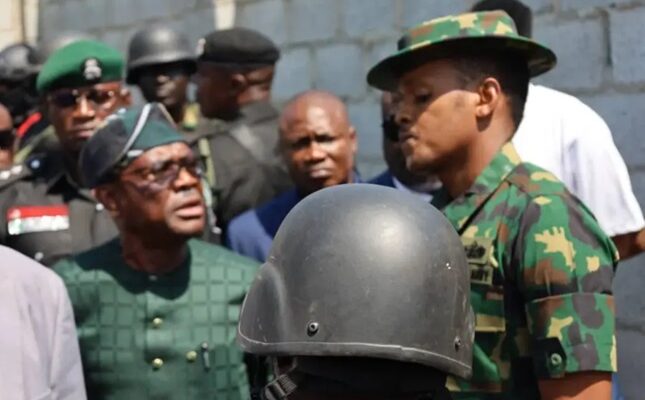

The events of November 11, 2025, in Abuja were more than a clash of egos; they were a dangerous crack in the spine of Nigeria’s democracy. When Nyesom Wike, Minister of the Federal Capital Territory, confronted and verbally assaulted a uniformed officer of the Nigerian Armed Forces at a disputed demolition site in the Gaduwa District, it was not just another flash of political bravado. It was a public humiliation of the very institution that guards the nation’s sovereignty — a visible wound on the honour of the uniform itself. Does it means they both parties representing the Federal Government cannot have indoor meeting to settle scores without this show of disgrace?
The video of the altercation, now viral across social media, captures a minister shouting orders at a soldier who calmly insists he is acting under superior command. The officer’s voice trembles with restraint, but his uniform speaks louder — it bears the emblem of the republic. In that moment, power met patriotism, and power lost its temper. As former Chief of Army Staff Tukur Buratai observed, Wike’s action “undermines the authority of the Commander-in-Chief and weakens the chain of command.” Former Aviation Minister Osita Chidoka called it “unacceptable,” warning that no public official has the moral right to berate the uniform that represents the state. Their reactions were not political; they were patriotic.
Across the world, no democracy survives when its soldiers are ridiculed by its ministers. The balance between civilian oversight and military discipline is fragile — and sacred. America learned this long ago. During World War II, General George Marshall told a U.S. senator who berated a soldier: “The day you humiliate the uniform is the day you weaken the flag.” The same principle holds true in Abuja today. A minister’s authority over the armed forces is not a license for insolence but a trust built on mutual respect. When that trust is broken in public view, it corrodes the morale of the men and women who risk their lives daily in forests, deserts, and seas defending a nation often too divided to defend itself.

Nigeria’s constitution leaves no ambiguity. Section 217 assigns to the Armed Forces the duty of preserving territorial integrity and suppressing insurrection. Those duties are carried out by human beings — soldiers whose courage holds this country together amid insurgency, kidnapping, and economic despair. To degrade one officer before cameras is to degrade them all. It sends the wrong message to the barracks, the wrong signal to terrorists, and the wrong precedent to every civilian leader. As Winston Churchill once warned, “Discipline is the soul of an army; without it, there is no courage, no victory, no safety.”
But beyond the legal and institutional implications lies a moral one. Nigeria’s leadership culture has for too long mistaken noise for strength and temper for authority. Wike’s outburst, like many others before it, reflects a deeper crisis — the erosion of restraint among those entrusted with power. True leadership is not measured by who can shout the loudest in public but by who can uphold the dignity of the state in silence. In the military, respect is not requested; it is earned through discipline and sacrifice. Civilians in authority must learn the same creed.
President Bola Ahmed Tinubu must now act, not with politics but with principle. The Commander-in-Chief must defend the honour of the institution that defends him. A clear, public reprimand and an apology from the FCT Minister to the Armed Forces would not only restore morale but reaffirm that no one — not even a minister — is above the decorum of office. Anything less would signal weakness at the top and invite chaos below.
An African proverb warns, “The child who mocks his father’s hut will one day rebuild it with ashes.” Nigeria cannot afford to rebuild its military discipline from the ashes of political arrogance. Our soldiers already fight too many wars — against insurgents, hunger, and hopelessness. They should not have to fight humiliation too.
The uniform is not a costume; it is the nation’s covenant stitched in courage. To assault it is to assault the Republic. The time for silence is over. If Nigeria must remain whole, then respect — not rage — must once again become the language of leadership.
– Inah Boniface Ocholi writes from Ayah – Igalamela/Odolu LGA, Kogi state.
08152094428 (SMS Only)