
Why interfaith education must begin in the classroom as Nigeria joins the world to celebrate World Teachers’ Day
By Abdulkarim Abdulmalik
As the world marks World Teachers’ Day on October 5, 2026, attention will naturally turn to classrooms, lesson plans, chalkboards, textbooks and the thousands of men and women who spend their working lives preparing young people for the future.

But there is another less discussed dimension to the work of teachers: their ability to build bridges between people of different faiths.
In a country like Nigeria, where Muslims and Christians constitute the overwhelming majority of the population and religious identity is often intertwined with community, politics and culture, the classroom can either become a place where prejudices are reproduced—or a place where understanding begins.
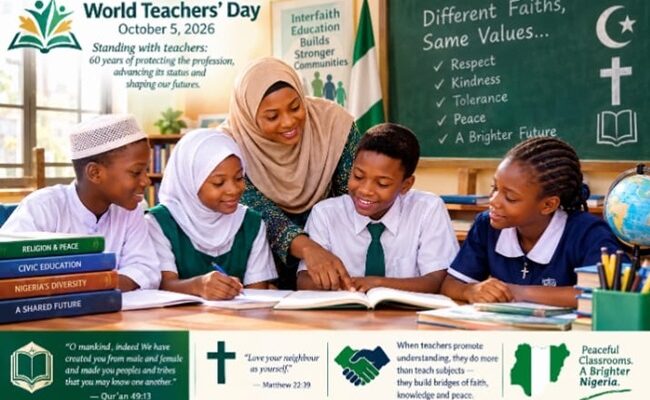
The theme of this year’s World Teachers’ Day, “Standing with teachers: 60 years of protecting the profession, advancing its status and shaping our futures,” provides an appropriate opportunity to reflect on that responsibility.
Teachers do not merely teach subjects. They help shape how young people see themselves, their neighbours and the wider society.
And when education is deliberately used to promote understanding between faith communities, the teacher becomes something more than an instructor. The teacher becomes a bridge-builder.
Education as a Shared Religious Value
Both Islam and Christianity attach enormous importance to knowledge and teaching.
The Qur’an begins its first revealed verses with a command that has become one of the most powerful foundations of Islamic intellectual tradition:
“Read in the name of your Lord who created.”
— Qur’an 96:1
The significance is difficult to overstate. The first word of the revelation is an invitation to learning.
The Qur’an also asks:
“Are those who know equal to those who do not know?”
— Qur’an 39:9
Christianity similarly places education, wisdom and teaching at the heart of faith.
The Bible declares in Proverbs 22:6:
“Train up a child in the way he should go; even when he is old he will not depart from it.”
And in the New Testament, Jesus Christ’s ministry was repeatedly described in terms of teaching. In Matthew 28:19–20, his disciples were instructed to go out, make disciples and teach them.
These passages from the Qur’an and Bible demonstrate a remarkable common ground: education is not simply the transfer of information; it is part of the formation of human beings.
That common ground offers Nigeria an important opportunity.
The Classroom as a Peace Laboratory
A child does not naturally emerge from the womb with hatred for another religion.
Much of what children eventually believe about people different from themselves is acquired through family, society, media, politics and education.
This places enormous responsibility on teachers.
Imagine a classroom where Muslim and Christian pupils learn not merely to tolerate one another but to understand each other’s traditions.
A Christian child can learn that Islam teaches Muslims to respect Jesus as one of God’s messengers.
A Muslim child can learn that Christianity places enormous emphasis on love, compassion, forgiveness and service to humanity.
Neither child has to abandon his or her faith.
Rather, both discover that understanding another religion does not necessarily weaken one’s own faith. It can strengthen one’s capacity to live peacefully with neighbours.
The Qur’an offers a powerful foundation for such an approach:
“O mankind, indeed We have created you from male and female and made you peoples and tribes that you may know one another.”
— Qur’an 49:13
The phrase “that you may know one another” is particularly relevant to interfaith education.
Knowledge replaces suspicion.
Dialogue replaces stereotypes.
Personal encounter replaces hearsay.
And understanding creates space for peaceful coexistence.
The Bible’s Message of Love
The Christian tradition offers an equally compelling foundation for interfaith engagement.
Jesus’ teaching in Matthew 22:39—“Love your neighbour as yourself”—extends the moral responsibility of believers beyond the boundaries of their immediate religious community.
The Parable of the Good Samaritan in Luke 10:25–37 is especially instructive.
The Samaritan belonged to a community that had significant religious and social differences with the Jews of his time. Yet Jesus used the Samaritan as an example of compassionate neighbourliness.
The lesson for today’s Nigeria is profound.
The identity of the person who needs our help should not determine whether we help.
Teachers can bring this principle alive in classrooms by encouraging students to understand religious diversity without turning difference into hostility.
Interfaith Education is Not Religious Indoctrination
There is sometimes a misconception that teaching children about other faiths amounts to asking them to compromise their own beliefs.
That is not necessarily the case.
Responsible interfaith education does not tell a Muslim to become a Christian or a Christian to become a Muslim.
It teaches students what their neighbours believe, why they believe it and how to disagree respectfully without becoming enemies.
Such education can be particularly important in Nigeria, where religious misunderstandings have sometimes contributed to tension and conflict.
A child who learns early that religious differences are normal is less likely to become an adult who regards difference as a threat.
Teachers Need Support
But teachers cannot carry this enormous responsibility alone.
Governments and educational authorities must provide training that equips teachers to handle religious diversity sensitively.
Schools should discourage religious stereotyping and ensure that pupils from different backgrounds are treated with dignity.
Teachers themselves must also demonstrate the values they teach.
It is difficult to teach tolerance if the teacher shows intolerance.
It is difficult to teach dialogue if the teacher refuses to listen.
And it is difficult to teach respect if students witness discrimination in the classroom.
The Prophet Muhammad, according to a well-known hadith recorded in Sahih Muslim, said:
“Whoever follows a path in pursuit of knowledge, Allah will make easy for him a path to Paradise.”
This powerful Islamic emphasis on the pursuit of knowledge reinforces the dignity of the teacher and learner alike.
Christian Scripture similarly reminds believers in James 1:19 to be “quick to listen, slow to speak and slow to become angry.”
Imagine the impact if these principles of listening, patience, knowledge and restraint became part of the culture of Nigerian classrooms.
From Tolerance to Friendship
Nigeria needs to move beyond merely teaching religious tolerance.
Tolerance can sometimes mean simply enduring the presence of another person.
What the country needs is something deeper: mutual respect, cooperation and friendship.
Teachers can encourage students to work together on community-service projects, environmental programmes, debates, cultural activities and peacebuilding initiatives.
A Muslim student and a Christian student who jointly clean their school environment may discover something more powerful than a textbook can teach: they are partners in building their community.
That experience can become the foundation of lifelong interfaith relationships.
The Teacher as a Nation-Builder
On World Teachers’ Day, therefore, Nigeria should celebrate teachers not only as educators but as nation-builders and peace-builders.
The teacher who teaches mathematics contributes to Nigeria’s economic future.
The teacher who teaches science contributes to its technological future.
But the teacher who teaches children to respect people of different faiths contributes to Nigeria’s peaceful future.
That contribution may never appear on an examination certificate.
It may never receive a national award.
Yet its impact can last for generations.
As the Qur’an declares:
“Cooperate with one another in righteousness and piety.”
— Qur’an 5:2
And the Bible reminds humanity in Romans 12:18:
“If it is possible, as far as it depends on you, live at peace with everyone.”
These are not merely religious quotations for sermons. They are principles capable of informing education policy and classroom practice.
The future of Nigeria will not be determined only by what children learn from textbooks, but also by how they learn to relate to one another.
If teachers can help a new generation understand that religious diversity is not a curse but a reality that can be managed through knowledge, respect and dialogue, they will have accomplished something extraordinary.
On World Teachers’ Day, the message should therefore be clear: when we stand with teachers, we stand with education; when we strengthen education, we strengthen understanding; and when we strengthen understanding between faith communities, we strengthen the foundations of peace.
For Nigeria, that may be one of the most important lessons the classroom can teach.
– Abdulkarim Abdulmalik is Chairman, Governing Board, Guild of Interfaith Media Practitioners Nigeria (GIMP-Nigeria). Email: nowmalik@gmail.com; info@interfaithmediaguild.org; interfaithmediaguild@gmail.com; Website: https://interfaithmediaguild.org