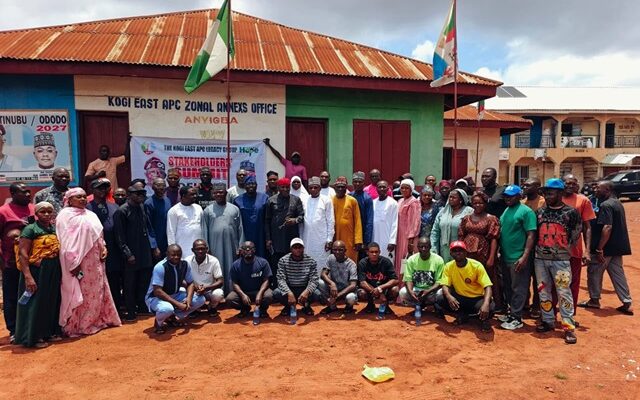

The Kogi East APC Legacy Group has launched grassroots town hall meetings across the nine local government areas of the senatorial district to rally support for purposeful engagement with the state and federal governments, as well as with other regional blocks in the state, to address Kogi East’s urgent development priorities.
The Group, which has commenced the strategic initiative in the Dekina and Bassa Local Government Areas, said that as the state’s most populous senatorial district and largest voting bloc, Kogi East holds decisive leverage. However, it noted that the Constitution’s requirement for a statewide spread of votes makes alliances and negotiations with Kogi Central and Kogi West imperative, not optional.
Such partnerships, it said, would also lay the foundations for equitable power-sharing and a negotiated development programme for the district, principles that past successful political leaders in the East had vigorously pursued.

According to a report by Dr Johnson Musa, the Group explained that, under the Constitution, a governorship candidate must receive the highest number of votes cast statewide and at least 25 per cent of the votes cast in each of at least two-thirds of the state’s local government areas. In Kogi State, which has 21 local government areas, the candidate must therefore meet the 25 per cent threshold in at least 14. With nine local government areas, Kogi East cannot meet that threshold on its own, however decisive its numbers.
As proof of that principle, the Group cited the late Prince Abubakar Audu’s performance in the initial 2015 governorship poll, which showed the value of building political support across the state’s three senatorial districts. Although the APC won 16 of Kogi State’s 21 local government areas in the initial poll, it secured more than 25 per cent of the valid votes in all 21 LGAs, exceeding the constitutional spread requirement of at least 14 LGAs.
The Dekina and Bassa town halls mark the start of an awareness programme planned for all nine local government areas in Kogi East, bringing together ward-level stakeholders and political veterans, including those who served in the administration of the late Prince Abubakar Audu and in other progressive governments in the state, to discuss regional alliances, power rotation, public accountability and infrastructure priorities.
Mr Dan Okolo, one of the Group’s leaders, a seasoned journalist, pioneer Director-General of Information at the creation of the state in 1991, former Hon Commissioner, and special adviser to various administrations in the State, said at the meetings in Dekina and Bassa LGAs that intensive grassroots development should be Kogi East’s foremost priority, hence the need to develop new, pragmatic initiatives grounded in sound political alliances and negotiation.
He called for sustained engagement with government at all levels to address infrastructure needs, ensure equitable power sharing, and improve living conditions across communities. He added that the district’s political aspirations would be better served by durable relationships with the other regions in the state in a manner that is mutually protective and based on shared development goals.
Okolo said the Group’s engagement with Governor Ahmed Usman Ododo had demonstrated the Governor’s commitment to prioritising critical infrastructure in Kogi East. He cited the invitation to tender for the reconstruction of the 37-kilometre Idah–Onyedega Road in Ibaji and the 13-kilometre Odenyi–Oguma–Sheria Road in Bassa as one of the requests referenced in the Group’s statement of 7 September 2026. The Group added that it would continue to monitor contract awards and project execution in critical areas.
He also reported approval for 12 solar-powered water schemes: four in Bassa, serving Mozum, Gboloko, Oguma and Ikende; four in Ibaji; and four in Omala. Work on the Bassa schemes had commenced, and the geophysical survey was complete. The group had advocated these water schemes for these communities, which were critically underserved.
Okolo also noted that the state government had approved the reconstruction of nine secondary schools in Kogi East, one in each local government area, under the World Bank-assisted AGILE programme. He said that distributing the projects across all nine local government areas would promote more equitable access to education. He added that the government was prioritising other requests the Group had submitted and promised to sustain this engagement with transparency, honesty, and courage.
The Group described the emphasis on negotiating for development as a continuation of the late Prince Abubakar Audu’s vision to develop every section of Kogi State and improve livelihoods. It noted that Audu prioritised the state’s unity and built political relationships across its communities and three senatorial districts. The Group stressed that political discussions must therefore centre on the well-being of Kogites, the unity of the state and the equitable distribution of amenities, rather than personal political interest.
Alhaji Abdullahi Haruna, SAN, who served as Solicitor General during Audu’s first administration in 1992 and as Attorney General from 1999 to 2003, urged stakeholders to uphold that legacy by bringing citizens closer to government and ensuring that political participation produces tangible benefits.
Haruna explained that the Group focused on engaging governments and people at the grassroots, building relationships that promote development, particularly in Kogi East, where infrastructure deficits remain a pressing concern. He maintained that politics focused on personal gain rather than public service lacked legitimacy.
He said the town halls provided an opportunity to listen to residents, identify their critical needs and engage the government on measures to address them. He explained that this approach would help move the region forward, recalling that engagement between community groups and the government under Prince Audu had led to the implementation of critical infrastructure projects.
He said the initiative was focused on supporting the people and improving their well-being. Through its engagement with communities across the state, particularly in Kogi East, the Group understood the challenges residents faced and was prepared to support efforts to improve their living conditions. Haruna welcomed the state government’s response and expressed confidence that the engagement and progress could be sustained.
Haruna also stressed that unity and equity were essential to accelerating development in Kogi State. He described ethnic and political rivalry as the greatest challenge Prince Audu faced, recalling that some of the strongest opposition to the Obajana Cement project came from politicians in the senatorial district where it was located. He said the government resisted those distractions, and the project had grown into what he described as one of the world’s largest cement factories. Haruna called for a change in political mindset, urging Kogites to place the state’s transformation above ethnic and partisan rivalry.
Speaking at the event in Dekina Local Government Area, a former Majority Leader of the Kogi State House of Assembly, Hon. Moses Idoko Ododo, said the time had come for Kogi East to prioritise the politics of development over individual aspirations for power. He noted that the district had suffered significant setbacks and said the Governor’s present commitment to the development Kogi East deserved the people’s support.
Also speaking, Hon. Salisu Adakeke, a former Majority Leader of the Kogi State House of Assembly and longstanding supporter of the late Prince Abubakar Audu, who led the Bassa stakeholders, commended the Governor’s determination to address infrastructure challenges across Kogi State. He welcomed the progress on the interventions in Bassa.
Adakeke said these interventions had renewed hope among the people and expressed confidence that sustained development efforts would translate into substantial electoral support for the APC.
The Group commended Governor Ododo’s administration for its response to infrastructure concerns raised by Kogi East stakeholders. It said constructive engagement should be accompanied by continued attention to project implementation, equitable access to public investment and accountability to the communities concerned.
Beyond these interventions, the Group renewed its request for priority attention to the wider infrastructure needs set out in its memorandum to the Governor. These include a national electricity transmission substation in Kogi East, sustainable rural water schemes, the rehabilitation and equipping of general hospitals, and phased improvements to public primary and secondary schools.
It also called for attention to the remaining road priorities, including Ankpa–Abejukolo, Anyigba–Iyale–Abejukolo and Ejule–Alloma–Otukpa Junction, alongside sustained engagement with the Federal Government on the Itobe–Anyigba–Ankpa–Otukpa, Idah–Odolu–Nsukka and Dekina–Shintaku corridors.
The Group reiterated the need for stronger security in boundary communities, farming areas and along transit routes. On coal mining in Ankpa and oil extraction in Ibaji, it called for fair and visible benefits for host communities and the wider state.
Concluding the engagements, the Group urged ward leaders to strengthen party cohesion, sustain dialogue with their communities and communicate local development priorities through the appropriate party and government channels. It reaffirmed its commitment to working with stakeholders across Kogi East, Kogi Central and Kogi West to promote inclusive development and strengthen public confidence in governance.