
By Abdulmalik Dauda
In many traditional communities across Northern Yorubaland and the Niger–Benue axis, there are traditional stools whose meanings run much deeper than their names suggest. Some of these titles have survived wars, migrations, Nupe expansion, colonial rule, and changing political realities for centuries. Others changed names over time but retained their meanings within traditional governance systems.
One of the most fascinating examples is the traditional office variously known today as Shaba, Saba, Akogun, or Balogun. To many people, these names merely sound like military titles. But a closer historical examination reveals something far more profound. Across several Yoruba frontier societies and neighbouring Middle Belt communities, these titles repeatedly appear as institutions connected with military authority, deputy rulership, succession, continuity of governance and stabilization of the throne.

Historical evidence suggests that the name “Shaba” was not originally what many Northern Yoruba communities called the office. Rather, it emerged more prominently during the period of Nupe military influence and political interaction across parts of present-day Kogi and adjoining regions between the late eighteenth and nineteenth centuries.
Historically, Nupe expansion toward Kabba Province and neighbouring Yoruba frontier territories intensified particularly between approximately 1810 and 1897, during the era of the Fulani Jihad and the subsequent rise of the Nupe emirate system under rulers such as Etsu Masaba (1859–1873) and later Etsu Umaru Majigi (1873–1884). During this period, Nupe military campaigns, tribute systems, and political influence penetrated large sections of Yagba, Bunu, Oworo, Ijumu, Kakanda, and Akoko frontier territories.
When Nupe forces and political influence spread into several Yoruba frontier territories centuries ago, they encountered already established traditional hierarchies. In many of those communities, the traditional titles immediately after the king were occupied by senior military chiefs known traditionally as Akogun or Balogun. These offices were not merely war titles; they were deeply connected to seniority, deputy authority, and succession line-ups within the indigenous Yoruba political structure.
The Nupe, however, already possessed a comparable traditional title within their own political system known as “Shaba” — a title associated with the heir apparent, deputy ruler or successor-in-waiting within Nupe traditional governance. Consequently, when they encountered similar continuity structures among the Yoruba frontier communities, they naturally applied the familiar designation “Shaba” to those offices.
In effect, the Nupe name aligned closely with the traditional role they met on the ground.
Thus, in many Northern Yoruba communities, the title Shaba gradually became attached to offices that were originally Akogun or Balogun in indigenous political tradition. What occurred, therefore, was not the creation of a new title; rather, it was a renaming or reinterpretation of an already existing traditional title.
This alignment is historically significant because the traditional Yoruba structure itself already positioned the Akogun or Balogun as military head, second-in-command, and, in many instances, succession authority after the king.
Perhaps one of the clearest surviving examples today comes from Kakanda Kingdom in present-day Kogi State. During recent succession discussions relating to the Agankyu stool, traditional authorities publicly described the office of the Shaba of Kakanda in remarkably explicit official terms. One traditional account stated: “Central to the succession system is the office of the Shaba of Kakanda, which by long-established custom is the position of heir apparent.” That statement is historically important for several reasons. It confirms that within that traditional political system, the Shaba functioned simultaneously as deputy ruler, heir apparent, successor-in-waiting, and continuity mechanism for the throne. In essence, the office formed part of the official bridge between one reign and another.
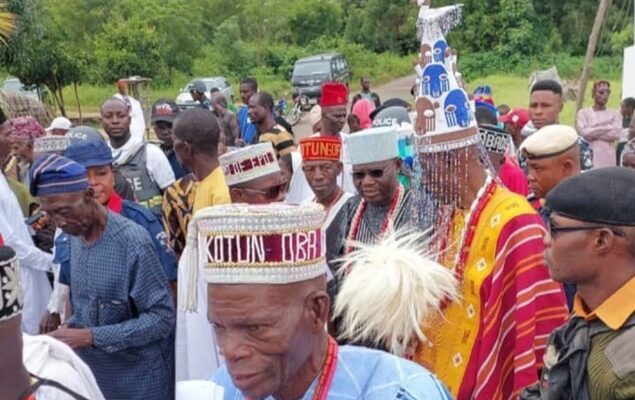
A remarkably similar structure survives within Ife-Olukotun in present-day Yagba East Local Government Area of Kogi State, where historical traditions indicate that the office of Akogun had already existed as the recognized second-in-command to the Olukotun long before the nineteenth-century phase of Nupe expansion into the region.
Oral traditions within Ife-Olukotun place the institutional existence of the Akogun at roughly about 300 years ago, around the early to mid-eighteenth century, even before the gradual transition from the older Ajalorun authority structure into the present Olukotun dynasty. Historically, the Akogun was not regarded merely as a war chief. The office embodied senior military authority, deputy rulership, succession continuity, and stabilization of the throne whenever vacancies occurred.
Significantly, oral traditions within the community consistently maintain that the Akogun, later also called Shaba during the period of Nupe influence, occupied the position immediately after the Olukotun in both hierarchy and succession expectation. Whenever the Olukotun stool became vacant, the Akogun/Shaba was traditionally regarded as the highest continuity authority within the political system.
In neighbouring Igbagun community within the same Yagba axis, similar traditions exist whereby the Shaba title holder functions as second-in-command and succeeds the Olugbagun whenever the stool becomes vacant. These recurring institutional patterns strongly suggest that the office itself predated the later Nupe terminology attached to it.
Interestingly, recent cultural developments across parts of Northern Yorubaland increasingly show transitions from the later Nupe-derived terminology “Shaba” back toward older Yoruba institutional names such as Akogun and Balogun. Similar re-emphasis of indigenous nomenclature can now be observed in Isanlu and Ere in Yagba East and Yagba West, respectively, other Okun-Yoruba communities.
Seen together, these examples strongly reinforce the argument that what survived across these frontier societies was not simply a military title, but an enduring indigenous institution deliberately designed around continuity of rulership, deputy authority and succession stability. What makes this even more significant is that similar institutional patterns appear repeatedly across Northern Yorubaland.
Colonial intelligence reports and later historical studies on Kabba Province, Akoko, Yagba, Igbomina, Owe and neighbouring frontier regions reveal that British administrators encountered highly organized indigenous political systems with layered structures of authority, military organization and continuity tendencies from the early colonial years beginning around 1900 after the fall of the Royal Niger Company territories and British consolidation of Northern Nigeria.
One important archival source frequently cited by historians is NNAK SNP 10 393P/1918, Assessment Report on the Aworo District of the Kabba Division written in 1918 by C.K. Meek, Assistant District Officer. Meek later became one of the most influential colonial anthropologists and administrators in Northern Nigeria during the 1920s and 1930s. The report and related colonial intelligence records became foundational materials for later historians studying political institutions in Kabba Province and Northern Yorubaland.
These records clearly showed that many communities already possessed traditional systems built around ranked authority, senior military chiefs, and continuity-sensitive traditions long before modern local government administration emerged under British indirect rule in the early twentieth century
Historical studies on Akoko political development also reveal the existence of titles such as Shaba, Madaki, Zaki, and Dawodu within local governance systems during the nineteenth and early twentieth centuries. What is particularly fascinating is that while names evolved over time, the institution itself survived.
Today, there is a growing cultural and historical shift across several Northern Yoruba communities toward re-emphasizing the original Yoruba titles ,especially Akogun and Balogun , while gradually downplaying the later Nupe-derived nomenclature “Shaba.”
This shift became increasingly noticeable from the late twentieth century into the early twenty-first century as cultural revival movements, indigenous historical research, and renewed interest in Yoruba political identity expanded across Okun-Yoruba communities.
This shift is not necessarily a rejection of history. Rather, it represents an attempt to reconnect the titles with its older Yoruba political roots and indigenous official and traditional identity.
In many communities, scholars, traditionalists, and cultural custodians increasingly argue that Akogun and Balogun more accurately reflect the original traditional offices that existed before Nupe influence renamed or reinterpreted them.
Importantly, the transition concerns terminology more than function. The institution itself remains substantially intact. Indeed, the same continuity philosophy appears across wider Yorubaland.
In Ibadan, for example, the famous Olubadan succession system, which evolved during the nineteenth century after the collapse of the old Oyo Empire around the 1820s, remains fundamentally organized around progression through senior military and civil chieftaincy lines. Historically, the military line headed by offices such as Balogun formed one of the principal constitutional routes to kingship. In this arrangement, military seniority became directly connected to continuity of rulership.
The same principle existed in old Oyo political traditions between the seventeenth and early nineteenth centuries where the Aremo functioned as crown prince while senior military chiefs exercised major influence within governance and succession politics.
In Ilorin too, especially after the establishment of the emirate in the 1820s following the Afonja era and Fulani intervention, offices such as Balogun and Madawaki became strategically important not merely because of military responsibility, but because continuity of authority and military organization of the emirate.
Seen from this broader historical perspective, the transition from Shaba back to Akogun and Balogun represents not merely a linguistic adjustment but a broader cultural recovery of indigenous political memory. What survives in these titles today is far more than old nomenclature. It is the living continuity of an ancient political philosophy. The one in which military authority, deputy rulership, succession stability, and continuity of governance were deliberately woven together into enduring traditional institutions.
— Abdulmalik Dauda, a scholar and anthropologist, lives in Lokoja.