
By Tunde Olusunle
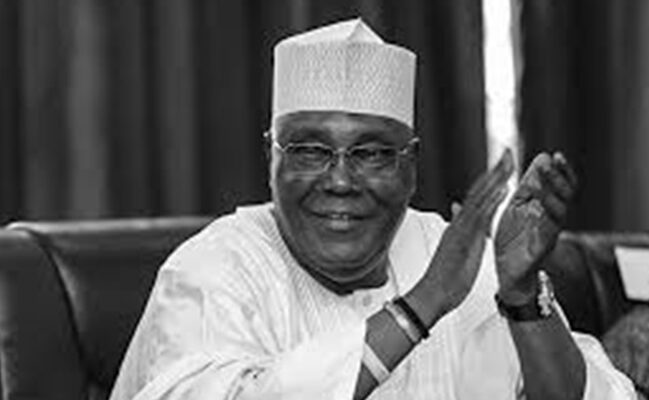
His reputation as a genial, genteel, generous gentleman precedes him. He wears calmness like second nature, barely ever betraying emotions, no matter what the apprehension or challenge is. Probably one reason he has soldiered in sprightly health towards the octogenarian rungs in a country where the average life expectancy is below 55 years. His capacity for accommodation, for doing good, is humongous, elastic. It is his DNA, maybe bolstered by the peculiar circumstances of his childhood. He has long known that people need a shoulder to lean on at some point. Within the limits of his resources, he feels an eternal obligation to intervene, to contribute to the alleviation of people’s troubles. He has suffered serial betrayal and backstabbing, but all of that have not impacted his person.
Many erroneously consider Atiku Abubakar, the first Vice President of Nigeria’s Fourth Republic, a softie because of his patriarchal disposition. Those who know him well, however, understand that he is a man of very strong convictions. He has shown time and again that we are not all bound by any law whatsoever, to lay on our couches, and train our heads and sights in the same direction when we sleep. We are entitled, as obtains in literary appreciation, to see the moon from different angles. Atiku has serially demonstrated his infinite capacity for independent thought and divergence of worldview. Indeed, he has demonstrably dissented, on issues he feels very strongly about. Political historians must not forget in a hurry, Atiku’s multiple battles in the law courts to salvage democracy and rule of law, from the grips of ultra-powerful and overbearing heads of government.

Call him a veteran of contemporary opposition politics in Nigeria and you will not be wrong. Atiku has put himself forward on a number of occasions so as to avail Nigerians an alternative leadership template. His policy document which has been regularly updated in conformity with times and trends, remains the most comprehensive, most practical and most achievable template for good governance and the realisation of the Nigerian dream for sustainable socioeconomic development. It has been suggested that Atiku was blatantly robbed of his well-earned victory at the 2019 presidential poll. A disenchanted polity did indeed vote for the alternative which the erstwhile Peoples Democratic Party, (PDP), presented in Atiku at the time, as against the flailing and floundering incumbent at the time, Muhammadu Buhari. The story of the server of the electoral umpire, the Independent National Electoral Commission, (INEC), which magically went dysfunctional when votes were being tallied and Atiku was in the clear lead, remains a blot on our electoral evolution.
The pliable agent-in-chief of the electoral body in that milieu, today lounges in the oriental comfort of a diplomatic post in the Middle East, as reward for that perfidy and similar, subsequent incests. Tragically, INEC’s performance has continued to dip every electoral cycle, even as larger democracies elsewhere, even in the Third World, continue to raise the standards of inclusion and real-time transparency. The very same 2019, India, with a population of almost 1.4 billion people and 900 million registered voters, recorded a voter turnout of 67%, which means 615 million people cast their ballots in a single election. Out of 82 million registered voters, just 28.6 million, representing 35.6%, turned out for the presidential poll in Nigeria in 2019. The figures were more depressing during the 2023 elections.
Along with other patriots including former top brass of the ruling All Progressives Congress, (APC), Atiku last July led the way to a political coalition to provide a counterpoint to the establishment, on the platform of the African Democratic Congress, (ADC). It has to be very serious business for a former national chairman of the APC and a Third Republic Governor like Chief John Odigie-Oyegun, and Nigeria’s longest serving Senate President till date, Senator David Alechenu Mark, to agree to coalesce to provide an alternative to the status quo. Atiku’s running mate during the 2019 presidential election and candidate of the Labour Party, (LP), during the 2023 version, Peter Gregory Obi and erstwhile flagbearer of the New Nigeria Peoples Party, (NNPP) in the same election, Rabiu Musa Kwankwaso, have also aligned with the coalition.
Former Governors who were hitherto APC leaders like Aminu Tambuwal, Nasir El Rufai, Rauf Aregbesola, Rotimi Amaechi; former Ministers Abubakar Malami, SAN, and Solomon Dalung, are equally members of the evolving coalition. Senators Enyinnaya Abaribe, Austin Akobundu, Ireti Kingibe, Binos Dauda Yaroe, among a dozen others, have equally pitched their tents with the ADC. There are also notable political leaders like Chief Onyema Ugochukwu; Senator Ben Obi; former Secretary to the Government of the Federation, (SGF), Babachir David Lawal and several members of the House of Representatives in the ADC train which continues to galvanise support and followership across the country. Governor Seyi Makinde of Oyo State and his Bauchi State counterpart, Bala Mohammed, are said to be in talks with the new coalition for possible integration. Such is the moss, the momentum which the ADC has garnered in less than one year of its coming to be.
In the same manner that the PDP was very obviously unsettled by the instrumentation of the state, no effort has been spared in allowing the ADC get a foothold. Malami and El Rufai have suddenly become regular guests of the anti-graft agencies. They’ve spent weeks and months between themselves, in prison cells and detention rooms, as the interrogations of their national service has suddenly taken centrestage. On the eve of its recent national convention, the ADC leadership of David Mark and Rauf Aregbesola was suddenly de-recognised by INEC, plunging the party into uncertainty. Attempts by the ADC to secure a venue for its convention became more difficult than the Biblical camel passing through the eye of a needle. APC chieftain, Adamu Aliyu, didn’t mince words when he said in an interview on national television that his party was responsible for “putting sand in the garri of the ADC.” He accused the ADC of poaching his party, APC leaders such as Aregbesola, El Rufai, Amaechi, Malami.
Viewed from whichever perspective, the APC looks very grounded for the 2027 general elections. At the last tally, the party had 31 governors, (three more than the 28 which the PDP had at the height of its ascendancy in 2003), and a very overwhelming majority in both houses of the national assembly. President Bola Tinubu has made more resources available to governors to strengthen their hands in service delivery to their constituents, than his predecessors which has bought their collective loyalty. Money na water, as Nigerian music artist, Onyenze, said in a 2024 song. There will be money in abundance for the government to throw around for the election. Added to these is that in Nigeria’s brand of totalitarianism, the institutions kowtow to the dictates of the ruling party. It has been proferred therefore, that in the same manner that the security services and chief pollster were procured to do the bidding of the establishment in times past, they remain as amenable as ever, to the subversion of popular will.
Despite these very obvious advantages, however, there seem to be palpable unease, jitters and panic in ranks of the establishment. Which explains the multilevel bumps and roadblocks being deliberately thrown on the path of the coalescing opposition. The Kabiru Turaki, SAN, faction of the PDP recently began robust engagements with the ADC towards a workable collaboration. One of the founding fathers of the PDP and Emeritus Minister, Prof Jerry Gana; former Chairman of the PDP, Uche Secondus, and former Chairman of the Board of Trustees of the party, Senator Adolphus Wabara, attended the exploratory exchanges. Erstwhile governors of Ebonyi, Cross River and Niger states, Dr Sam Egwu, Liyel Imoke and Babangida Aliyu, as well as the Oyo State Governor, Makinde, also featured at the interaction. Since the amalgamation of elements from four political parties back in 2013 to berth the APC to oust former President Goodluck Jonathan, there has been no bigger assemblage of political heavyweights in a single coalition as the ADC is shaping up to becoming. The spread and potency of the opposition without doubt, is getting broader and more pungent.
It takes tremendous goodwill, yeomanry, diplomatese and networking to bring such a diverse base of political leaders together for a common cause and Atiku should take deserved plaudits. It is certainly not his singular effort, but his centrality in rallying these disparate forces together for a common cause, is not moin-moin, as Nigerians will say in popular parlance. Atiku has said he will put himself up for the consideration at the presidential primary of the ADC, like every other willing aspirant. He has assured that he will throw his full weight behind whoever wins, even if such a choice is achieved by consensus, to ensure Nigerians get a breather, come 2027. He has equally stated with finality that the same 2027 will be his final shot at the presidency. The consummate politician that he is, he continues to lay the building blocks of a formidable political alternative. As the calendar ticks towards January 2027, interesting, maybe unpredictable times surely lie ahead for Nigerian politics.
– Tunde Olusunle, PhD, Fellow of the Association of Nigerian Authors, (FANA), teaches Creative Writing at the University of Abuja