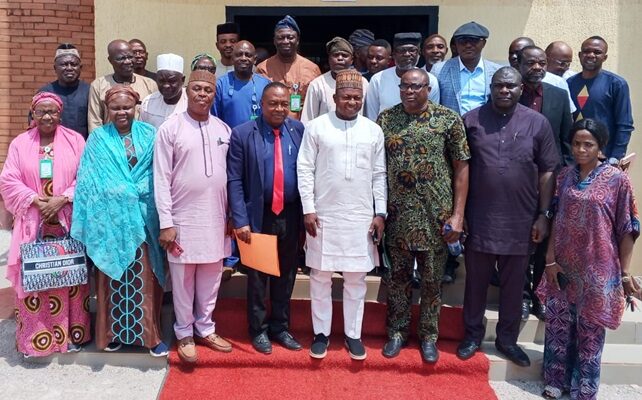

…Reaffirms commitment to academic excellence, infrastructure development
By Abdulkadir Bin Abdulmalik.
The Vice-Chancellor of Prince Abubakar Audu University (PAAU), Anyigba, Professor Salisu Ogbo Usman, has began his familiarisation tour across academic faculties of the University, reaffirming his administration’s commitment to strengthening academic programmes, improving infrastructure, enhancing staff welfare and promoting institutional reforms.

The visits, which began on Tuesday, 17th February 2026 with the College of Health Sciences, Faculty of Management Sciences, and Faculty of Education, formed part of the Vice-Chancellor’s strategic engagement with staff and students aimed at assessing operational realities, identifying challenges, and charting a collective path toward sustainable institutional growth.
At the College of Health Sciences, the Vice-Chancellor was received by the Provost, Professor S.P.O. Akogu, alongside members of the College management and staff.
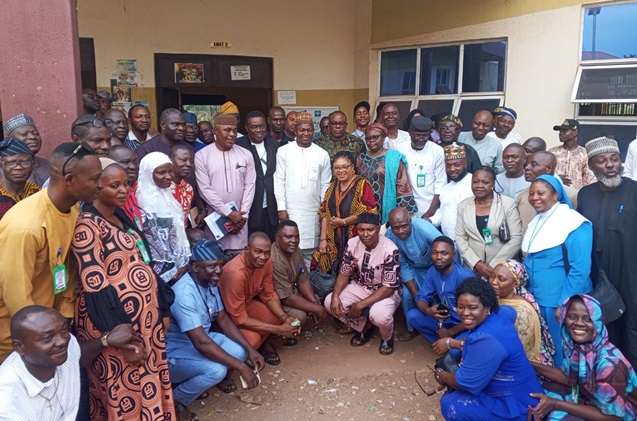
Welcoming the University management team, Prof. Akogu commended the Vice-Chancellor for making the College a priority during the familiarisation exercise, describing the visit as a strong signal of commitment to advancing medical education.
He provided an overview of the College’s evolution, noting that medical academic activities commenced in 2012 following approvals by regulatory bodies and that the Faculty of Medicine was upgraded to a College in 2015 to meet professional requirements.
According to him, the College was established to train high-level medical personnel capable of addressing healthcare needs within Kogi State and Nigeria.
The Provost highlighted the collaborative relationship between the University and the Prince Abubakar Audu University Teaching Hospital, which serves as the clinical training arm supporting medical education, healthcare delivery, and research development.
He also outlined progress recorded in infrastructure expansion, staffing improvements, and programme development, including the reactivation of the MBBS programme and accreditation of allied health courses.
While acknowledging these achievements, he identified critical needs such as additional staffing, improved ICT facilities, stable power supply, and acquisition of modern medical equipment to sustain accreditation standards.
Responding, Prof. Usman described his visit as deliberate, citing his administrative background in health sciences at the University of Ilorin.
He commended his predecessors and stakeholders for laying a solid foundation for the medical programmes and assured staff that his administration would consolidate existing gains.
The Vice-Chancellor noted that the College possesses competent professionals and strong structures capable of driving further growth, stressing that identified challenges are surmountable through unity, collective responsibility, and focused collaboration.
He reiterated his administration’s commitment to staff welfare and encouraged stronger partnerships with government and external bodies to attract research grants and expand opportunities for medical innovation.
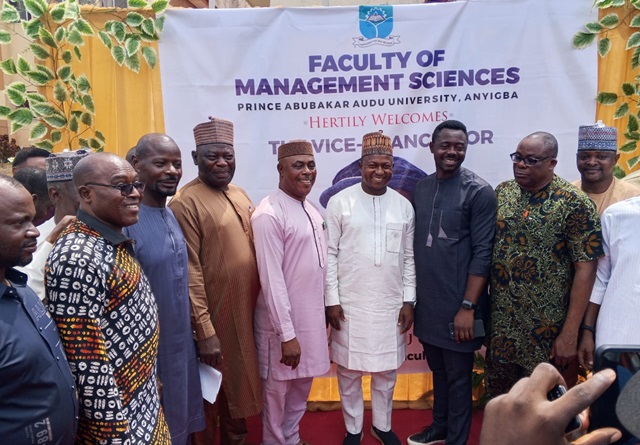
In a related development, the Vice-Chancellor visited the Faculty of Management Sciences and assured staff of deliberate efforts to address infrastructure deficits and deepen academic reforms across the University.
The Dean described the Vice-Chancellor’s emergence as symbolic of institutional maturity, noting that the Faculty remains one of the largest academic units, with a significant student population and strong postgraduate programmes that support the University’s academic ecosystem.
Despite its achievements, the Faculty identified challenges including overstretched lecture facilities, limited office spaces, power supply difficulties, safety concerns along access roads, and environmental disruptions caused by stray cattle.
In his remarks, the Vice-Chancellor commended the resilience and productivity of the Faculty, explaining that it was deliberately selected as an early point of engagement because of its strategic importance to postgraduate training and academic output.
He emphasised mentorship as a cornerstone of academic continuity and stressed that universities must function as problem-solving institutions capable of addressing societal challenges through research and innovation.
Prof. Usman reaffirmed his administration’s commitment to staff welfare and promised sustained efforts toward improving teaching and research facilities.
The Vice-Chancellor also issued a stern warning against indiscipline, extortion, and unethical practices capable of undermining the integrity of the university system.
He announced plans to reorganise key institutional directorates, including the Information Technology and Resource Centre (ITRC), Quality Assurance and Advancement, and Linkages and Support, to enhance operational efficiency and global competitiveness.
He further assured staff that timely release of academic results would be prioritised, while non-functioning student hostels would be comprehensively reviewed for effective utilisation.
In the same vein, the Dean of the Faculty of Education, Professor Lawrence Achimugu, described the Vice-Chancellor’s visit as evidence of inclusive and participatory leadership.
He made the remark while receiving the Vice-Chancellor and his management team on a familiarisation visit.
He stated that the Faculty remains committed to the University’s mandate of knowledge dissemination, community service, and research development through sustained curriculum review, mentoring, and ethical academic practices.
The Dean highlighted the Faculty’s national recognition through students who received Presidential Awards during the National Youth Service Corps programme for outstanding community development efforts.
Prof. Achimugu explained that the Faculty contributes to community development through teaching practice programmes and expanding outreach initiatives for educational stakeholders.
He also disclosed ongoing affiliation processes with Kogi State College of Education Ankpa and Calvin Foundation College of Education Naka, aimed at strengthening academic collaboration and boosting internally generated revenue.
He, however, outlined challenges including shortage of academic staff, inadequate lecture theatres, deteriorating classroom furniture, insufficient office accommodation, and limited support personnel.
The Faculty also appealed for approval of new academic programmes such as Guidance and Counselling and Agricultural Education to expand its academic offerings.
In response, Prof. Usman commended the Faculty’s achievements despite constraints and assured staff that issues raised would receive attention.
He reiterated that education remains central to national development and urged staff to sustain mentorship, professionalism, and ethical standards necessary for producing responsible graduates.
Across the three visits, the Vice-Chancellor consistently emphasised collaboration, discipline, mentorship, and shared responsibility as essential drivers of institutional progress.
He paid tribute to former Governor of Kogi State, Yahaya Adoza Bello, and the incumbent Governor, Ahmed Usman Ododo, for their continued support toward the growth of the University and improvement of staff welfare.
17/02/26