
It has become necessary, at this critical juncture, to intervene in the ongoing public conversation with facts, historical context, and political maturity.
Governance must never be reduced to sentiment, selective memory, or orchestrated narratives divorced from verifiable records.
Since the advent of the Fourth Republic in 1999, Yagba Federal Constituency has been represented by five (5) Members of the House of Representatives. When these tenures are objectively examined against measurable indices, visibility, constituency engagement, human capital development, infrastructural facilitation, empowerment programs, and legislative relevance. Elder Leke Abejide unmistakably emerges as the most impactful representative the constituency has produced to date, and this by a clearly discernible margin.

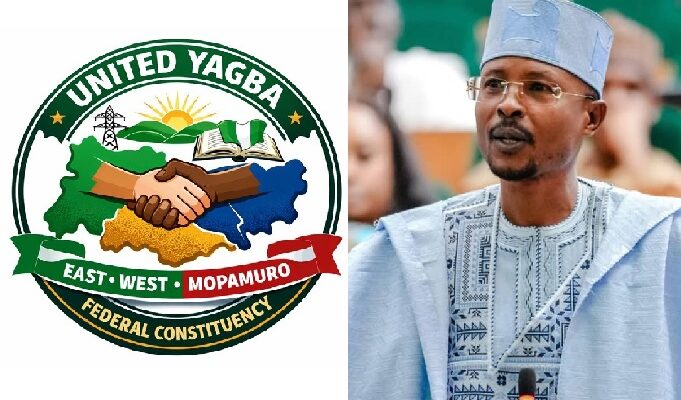
This position is grounded in evidence, not rhetoric. Across education support, youth and women empowerment, healthcare interventions, employment facilitation, road and community projects, and sustained interface with constituents, his interventions cut across Yagba East, Yagba West, and Mopamuro without discrimination. There exists no factual or documented basis to suggest that Mopamuro Local Government has been excluded from his governance footprint.
Consequently, the persistent attempt to frame his performance under the narrow and misleading label of “projects in Mopamuro” is not only intellectually dishonest but politically reductionist.
If no part of the constituency has been marginalised, then the agitation for abrupt change becomes fundamentally illogical. Change, in democratic practice, is a response to failure, not a punishment for performance. Where progress is evident, the rational political response is consolidation, not disruption.
It must be clearly stated that no representative’s performance should be evaluated in isolation or through parochial lenses. Leadership at this level is constituency-wide, strategic, and cumulative. To deny the totality of work done because it does not conform to sectional expectations is to undermine the very essence of representative democracy.
Against this backdrop, it must be stated clearly and without equivocation:
Elder Leke Abejide remains the most credible, competent, and strategically positioned candidate for the 2027 election. His experience, institutional understanding of the National Assembly, proven capacity for constituency engagement, and demonstrated commitment to inclusive development make him best suited to consolidate existing gains and deliver even greater outcomes in subsequent years.
The principle of continuity is neither novel nor controversial in governance. Nigerians embraced continuity at the federal level with Asiwaju Bola Ahmed Tinubu, not because perfection was claimed, but because policy maturation requires time. Kogi State, under Governor Ahmed Ododo, continues in the same spirit, prioritising stability, completion, and institutional strengthening over political impatience. Yagba land cannot logically exempt itself from this universally accepted governance principle.
Elder Leke Abejide has demonstrated commitment, resilience, and an uncommon level of constituency responsiveness. His performance is visible, measurable, and historically comparative. Those with political discernment will recognise that his level of engagement transcends tokenism and reflects deliberate representation.
This intervention is not intended to silence dissent, but to elevate the discourse. Democracy thrives on accountability, yes, but accountability must be anchored on truth, fairness, and intellectual honesty. To acknowledge performance is not sycophancy; it is political objectivity.
History is an impartial judge. It will record who spoke with facts, who acted with wisdom, and who prioritised collective progress over transient political theatrics. Let us therefore choose maturity over misinformation, consolidation over chaos, and evidence over emotion.
– Ola~Strategy wrote from Isanlu.