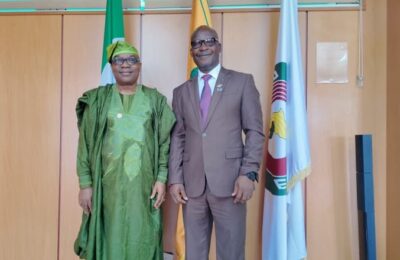
In a political climate increasingly defined by noise, spectacle, and short-term calculations, steady and institutional leadership has become a rare but invaluable asset. Distinguished Senator Sunday Karimi exemplifies this form of leadership—and that is precisely why he matters to Kogi West, the All Progressives Congress (APC), and Kogi State as a whole.
Senator Karimi’s leadership pattern is deliberate rather than performative. He operates within institutions, understands legislative process, and prioritises outcomes over theatrics. In a system where influence is earned through consistency and credibility, this approach is not just prudent—it is effective.
For Kogi West, his focus has remained firmly on foundational issues: security, infrastructure, and sustained federal engagement. His persistent advocacy for critical road corridors and community safety reflects a practical understanding of development. Roads are not slogans; they are economic lifelines. Security is not rhetoric; it is the basis of social stability and growth.

Beyond his senatorial district, Senator Karimi has increasingly come to represent Kogi State itself within national governance spaces. His engagements, interventions, and relationships at the federal level project Kogi as a serious stakeholder in Nigeria’s political and developmental conversations. In a federation where visibility often determines priority, his presence helps ensure that Kogi’s interests are neither marginalised nor misunderstood. This broader representational role strengthens the state’s bargaining position and reinforces its relevance beyond parochial boundaries.
Within the APC, Senator Karimi represents stability and maturity at a time when parties require cohesion more than internal turbulence. His brand of politics aligns loyalty with responsibility, reinforcing the principle that ruling parties must deliver governance, not merely dominate the political space. Such balance strengthens both the party and public trust.
Kogi State—often associated with political volatility—benefits from leaders who reduce friction while increasing institutional relevance. Senator Karimi’s ability to engage the federal centre constructively, without losing touch with grassroots realities, positions the state more strategically within national decision-making structures.
Beyond politics, his value lies in his understanding of continuity. Development is not an event; it is a sequence. His interventions show an appreciation for policy follow-through—where advocacy does not end at appropriation, and oversight does not stop at announcements. This long-view approach is critical for a state that has suffered more from abandoned processes than from lack of ideas.
Equally important is restraint. Leadership is not measured by constant confrontation or public bravado, but by discipline, negotiation, and results. Senator Karimi’s refusal to inflame divisions or pursue populist shortcuts is not weakness; it is statesmanship.
The New Year Message as Evidence
Senator Karimi’s 2026 New Year message offers practical insight into this leadership philosophy. Rather than resorting to vague optimism, he confronted uncomfortable realities—acknowledging the security breaches that disrupted communities in Kogi West and mourning lives lost. This willingness to name problems directly reflects a governance style rooted in responsibility, not denial.
By identifying specific federal road corridors requiring urgent attention, the message reinforced his results-oriented approach to infrastructure. The focus was not on abstract development, but on concrete assets that drive security, commerce, and social life. His emphasis on national security coordination and institutional collaboration further underlined a systems-based understanding of governance.
Notably, the message also situated Kogi West—and Kogi State more broadly—within national relevance, highlighting federal appointments as recognition of the state’s human capital rather than personal patronage. The tone was sober, forward-looking, and anchored in continuity—renewal without disruption, progress without populism.
In a political culture allergic to benchmarks, the true test of leadership is not intention, but execution—and this is the standard against which Senator Karimi’s stewardship should continue to be assessed.
In an era of growing public scepticism, political assets are those who understand process, timing, and consequence. Kogi West requires representation that delivers durable gains. The APC requires leaders who convert power into performance. Kogi State requires figures who project seriousness, competence, and continuity. In a political era obsessed with urgency and spectacle, leadership that is patient, methodical, and results-driven is not only rare—it is necessary.
Distinguished Senator Sunday Steve Karimi fits this profile—not as a flawless figure, but as a functional, results-oriented leader in a system that desperately needs functionality. In today’s Nigeria, that is no small contribution.
— Ahmad M.A.
For: Kogi Equity Alliance (KEA)