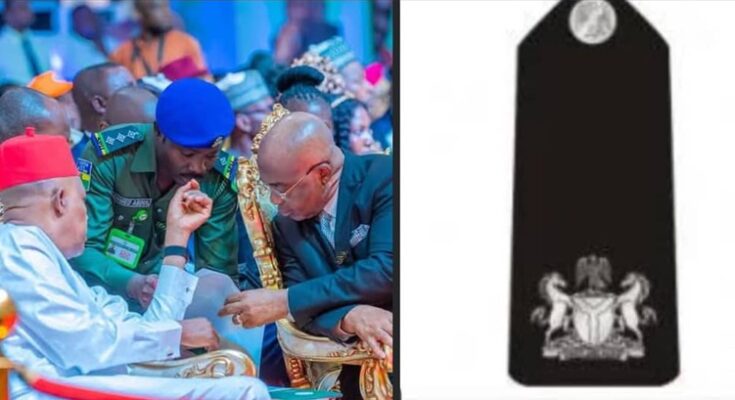

“Gratitude is a daily practice. Al-ḥamdu lillāh.” — Ahmed Abdul Mumin Superintendent of Police
In a polity where public office is frequently confused with entitlement and elevation is often mistaken for personal conquest, a restrained sentence can function as quiet resistance. Ahmed Abdulmumin’s response to his promotion to the rank of Superintendent of Police does exactly that. It rejects triumphalism. It resists vanity. And in doing so, it restores moral seriousness to what promotion in public service ought to mean.
Promotion within the Nigeria Police Force is not ceremonial. It is a recalibration of power. Rank expands discretion, deepens authority, and magnifies the consequences of judgment. It determines who stops whom, who commands force, who exercises restraint, and who is believed when power meets vulnerability. In a country where citizens routinely encounter policing as fear rather than protection, elevation in rank is not a reward; it is a moral test.

Power in uniform is never neutral. In the wrong hands, it degenerates into intimidation, extortion, and normalized abuse. In the right hands, it becomes something rarer and more valuable: lawful authority exercised with restraint. The difference between the two is not training manuals or slogans. It is character.
This is why Abdulmumin’s words matter. Gratitude is not the language of entitlement. It is the language of stewardship. To acknowledge God at a moment of elevation is to recognize that authority is borrowed, not owned; delegated, not inherent; answerable, not absolute. It is an admission that rank does not suspend accountability but intensifies it. In an environment where many ascend as though they have arrived at final authority, such consciousness is not decorative. It is corrective.
Nigeria’s policing challenge is not primarily logistical. It is moral. The crisis is not the absence of uniforms, weapons, or commands; it is the erosion of trust. Citizens fear the badge because restraint has become unpredictable and accountability episodic. In this context, the personal conduct of individual officers carries institutional consequences. The uniform amplifies virtue just as it magnifies vice.
Those familiar with Abdulmumin’s service consistently describe an officer who understands this burden. Firm without cruelty. Disciplined without arrogance. Deliberate rather than impulsive in the use of authority. These are not soft attributes. They are the operational difference between law enforcement and lawlessness in uniform. They determine whether the police are experienced as guardians or predators.
Equally revealing is his relationship with the community beyond formal duty. Abdulmumin is widely known as a quiet philanthropist. Not philanthropy as performance, not charity as branding, but assistance rendered without publicity to the vulnerable, families in distress, and young people in need of guidance and educational support. This matters because policing divorced from social empathy becomes coercive by default. Authority that does not understand the lived realities of the people it governs inevitably dehumanizes them.
Community trust is not manufactured through public relations. It is accumulated through daily encounters that leave citizens feeling protected rather than diminished. An officer who understands society as human, not merely procedural, is less likely to abuse power when discretion presents itself. In this sense, philanthropy and professionalism are not separate virtues. They are mutually reinforcing disciplines of restraint.
There is also a wider institutional lesson embedded in this promotion. Every elevation within a coercive institution is a signal. When officers known for discipline, humility, and community-minded conduct are promoted, the institution communicates its normative priorities. When a character is ignored, impunity is taught. Promotion is therefore never neutral. It is a policy by example.
Nigeria does not suffer from a shortage of powerful officials. It suffers from a shortage of responsible ones. Authority without moral grounding becomes predatory. Power without gratitude curdles into entitlement. Abdulmumin’s response to promotion suggests an understanding that rank is not a shield from scrutiny but an invitation to higher ethical demands.
It is therefore neither excessive nor sentimental to pray that officers who embody restraint, discipline, and service may rise as far as merit allows. Should Superintendent Ahmed Abdulmumin remain faithful to these values, many will quietly hope and pray that his career may one day reach the highest office of policing in Nigeria, even the Inspector-General of Police. Not as an ambition for power, but as an opportunity to institutionalize restraint, rebuild trust, and redefine what authority in uniform should look like.
The significance of this promotion lies not merely in the elevation of one man, but in the values his advancement affirms. In a public sphere exhausted by abuse of power, that affirmation is not trivial. It is necessary.
— Yusuf M.A., PhD