
Kogi State stands inside a moral emergency that can no longer be masked by political ceremony or manipulated by the vocabulary of incumbency. For thirty-two years, a narrow political class has acted as though the governorship were a hereditary title, fenced off from the people whose diversity gives the state its identity. They call this continuity; history calls it distortion. Democracy calls it inequity. And inequity, no matter how elegantly dressed, eventually meets its reckoning. That reckoning is 2027.
The question of 2027 is not about ambition or sentiment. It is a constitutional question. A historical question. A structural question about whether Kogi State intends to remain a coherent political community or dissolve into a geographic expression held together by force and pretence. Kogi was created from the old Kabba Province, a three-legged structure comprising Igala, Okun, and Kotonkarfe. That tripodal architecture is woven into the very DNA of the state. A house built on three pillars cannot stand forever on two.
Yet this is the political deformity Kogi has tolerated for over three decades. Kogi East and Kogi Central have produced governors for sixteen years each. Kogi West has produced none. Not one term. Not one opportunity. Not under the Northern Region, not under Kwara or Benue, and not in thirty-two years of Kogi State. No major zone in any Nigerian state has endured such prolonged exclusion. This distortion is not a technical anomaly; it is a structural injustice.

Section 14(3) of the 1999 Constitution forbids domination by any single bloc in the composition of government. It is not decorative language. It is an enforceable principle. The Supreme Court, in the A.G. Federation v. Abubakar case, affirmed that equity in representation is a foundational requirement for legitimacy. A state that practices internal domination cannot uphold external fairness. What applies to Nigeria applies, without dilution, to Kogi State.
Political science affirms the same. Stable federations distribute power; unstable ones hoard it. Canada rotates symbolic leadership. Switzerland rotates its presidency. India employs rotational chief-ministership in multi-ethnic states. Nigeria practises zoning at the federal level. If fairness is essential to large and strong democracies, it is indispensable to a small, diverse, and fragile state like Kogi.
But beyond law and theory, something far more profound is happening: the people themselves have become the engine of truth. The movement for 2027 has escaped the control of political merchants. It has spread across campuses, television platforms like UrahTv, IGALA TV, AIT, SYMPHONI, and into town halls, markets, religious centres, commercial parks, and community gatherings. Kogi West and Kogi East are now engaged in serious, sincere, and strategic dialogue to return power to Kogi West in 2027. This is not a transaction; it is an awakening. It is the political revival Senator Sunday Steve Karimi captured during Kabba Day: fairness is the only legitimate pathway to stability.
The custodians of the old imbalance are shaken because the people are no longer listening to them. Their old tactics of stoking division between West and East have collapsed. Their propaganda has expired. Their monopoly on political storytelling is broken. When citizens begin to speak directly to one another, the middlemen of misinformation lose their power.
Kogi West is not making a plea. Kogi West is presenting a constitutional, historical, and democratic claim. Equity is not a favour. Representation is not a privilege. Inclusion is not a negotiation. A state cannot demand unity from a region it systematically excludes. It cannot preach peace while enforcing political starvation. It cannot claim legitimacy while denying one-third of its foundation the right to lead.
Those insisting that Kogi West should “wait again” must explain why they themselves never waited. They must explain why justice should be postponed when they never postponed their own access to power. No such argument exists. There is no moral, constitutional, mathematical, or historical logic that justifies the continued exclusion of Kogi West.
What stands before Kogi in 2027 is not an election. It is a referendum on justice. A test of whether the state will honour the principles that formed it or continue a two-zone monopoly that violates its own foundation. A test of whether Kogi will be a united state or a fractured political territory. A test of whether fairness still means anything in public life.
The people have delivered their verdict. The momentum is unstoppable. From Kabba to Anyigba, from Lokoja to Ankpa, from Yagba to Dekina, the call is clear and the logic is complete: Kogi’s political balance must be restored.
2027 is not a gift. It is a correction. It is not compensation. It is restoration. It is not sentiment. It is constitutional alignment. It is not ambition. It is justice long denied.
Kogi cannot enter its future carrying the distortions of its past. A state built on three pillars must stand on three pillars.
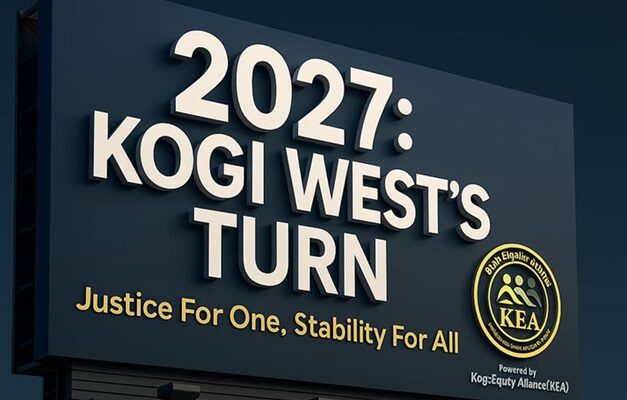
2027 is Kogi West’s turn — by history, by law, by fairness, by logic, and by the collective will of the people.
– Yusuf Muhammad
For: Kogi Equity Alliance