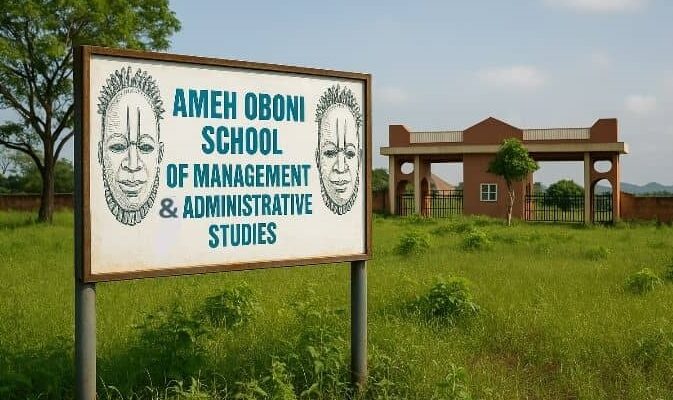

The future of a people is rarely lost in a battlefield; it is lost in quiet places; abandoned projects, forgotten visions, and dreams left to rot behind tall grasses. Along the Idah- Ajegwu Road stands one such silent warning: the Ameh Oboni School of Management and Administrative Studies, a project conceived to shape minds, strengthen local capacity, and birth the next generation of Igala thinkers and administrators. Today, it sits lonely in the bush, swallowed by weeds, exiled from the attention it deserves. Its desolation is not merely architectural; it is symbolic; a mirror reflecting what happens when a nation ignores its own possibilities.
In an era when tribes across Nigeria are clamouring for autonomy, self-development, and strategic empowerment, the Igala people cannot afford the luxury of indifference. A school is never just a building; it is a declaration that a people believe in their children enough to build a ladder for them to climb. The Ameh Oboni Institute, bearing the name of a king who stood fiercely for dignity and identity, was supposed to be such a ladder. But unfinished pillars now stand like abandoned testimonies, reminding us that a community that mismanages the small will inevitably lose the big. Development begins with the basics, with the courage to complete what was started. A society that cannot finish its school cannot build its destiny.
The tragedy is not that the school is hidden in the bush; the tragedy is that no united voice has risen loud enough to clear the way . The Igala nation, historically known for unity, hospitality, and collective strength, now stands at a crossroads. The call for an Okura State is not merely political aspiration; it is a plea for structured development, cultural preservation, and administrative independence. But how can a tribe demand a state when its own internal projects are crumbling? How do we claim readiness for administrative autonomy if institutions meant to train our administrators are choking in the wilderness? The abandoned school is not a weakness; it is a warning, urging a return to strategic unity.

What the Ameh Oboni Institute represents is bigger than its abandoned classrooms. It is evidence that the Igala agenda must be reclaimed with intentionality. Where others see a bush, visionaries must see a future campus: lecture halls humming with life, researchers developing indigenous administration models, and students from every corner of Nigeria arriving to study governance through an Igala lens. Diaspora sons and daughters; those in Abuja, Lagos, London, Atlanta; must recognise that development is not a spectator sport. The world respects communities that build themselves. The Igbo do it. The Yoruba do it. The Tiv do it. The Igala cannot lag behind. The voice of the people is the voice of democracy, but the responsibility of the people is the foundation of progress.
Therefore, this is not just a plea; it is a proclamation. Let the Igala people, at home and abroad, rise with one voice to resurrect the Ameh Oboni School of Management and Administrative Studies. Let philanthropists adopt classrooms. Let local governments clear the bush. Let traditional leaders champion the project with pride. Let political elites stop playing ostrich politics and show moral courage. Strategic unity is not a slogan; it is survival. From small foundations, great nations rise. From the revival of one school, a new chapter of Igala renaissance can begin. The Ameh Oboni Institute must not remain a dream buried in the wilderness; it must become the academic beacon that signals the rebirth of an entire people.
– Inah Boniface Ocholi writes from Ayah – Igalamela/Odolu LGA, Kogi state.
08152094428 (SMS Only)