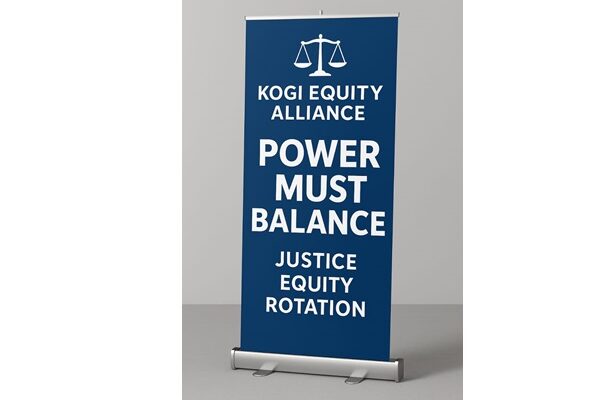

This agitation is spearheaded by the Kogi Equity Alliance (KEA), the foremost civic movement leading the organised, data-backed, and morally grounded push for fairness and balanced leadership in Kogi State.
As the 2027 governorship election approaches, the central question before Kogi State is no longer one of preference or political convenience. It is a direct test of whether a multi-ethnic society can continue to function on a foundation of imbalance that has lasted for 32 years. Since the state’s creation in 1991, Kogi West has never produced a governor. In stark contrast, Kogi Central is positioned to complete an extraordinary cycle of between 12 and 16 consecutive years in power. This is the longest period of regional domination in the state’s political history.
These are not campaign talking points. They are verifiable historical facts. And facts have consequences.

No diverse state anywhere in Nigeria or around the world sustains political stability when a single bloc holds executive leadership for that long. Prolonged monopoly of power creates predictable results: resentment, disengagement, structural distrust, and eventually political rupture. Kogi cannot pretend it is immune to these universal laws of democracy.
It is precisely this looming danger that the West–East Justice Coalition, under the leadership and intellectual guidance of KEA, has addressed through its comprehensive 2027 Power Shift Doctrine. This doctrine is built on five pillars: logic, fairness, demographic mathematics, historical evidence, and governance stability.
The first pillar is the undeniable exclusion of Kogi West for 32 years. A full generation has passed without the district experiencing executive leadership. This is not a rotational delay; it is a structural denial. Every North-Central state — Plateau, Benue, Kwara, Nasarawa, Niger, and even the Federal Capital Territory — has ensured that each zone has had a fair share of leadership as a tool of stability. Kogi is the only outlier. The consequences of this anomaly grow louder with every election cycle, as one part of the state continues to feel politically disenfranchised.
The second pillar is the strategic emergence of the West–East Alliance. This alliance is not sentimental; it is grounded in political arithmetic. The East is the largest voting bloc in Kogi State, historically delivering the highest voter turnout and vote volume. The West carries the most legitimate equity claim to 2027, backed by 32 years of exclusion. When numerical strength aligns with the strongest justice argument, the result is a coalition capable of reshaping the political balance of the state. This alliance is the most structurally sound political formula Kogi has seen since 1991.
Importantly, the alliance also outlines a clear power-sharing framework: Deputy Governorship for the East, representation quotas across strategic ministries, 40 percent appointments, and a guaranteed development pact for key Eastern LGAs including Dekina, Ankpa, Idah, Ofu, and Olamaboro. This is not politics of replacement; it is politics of balance.
The third pillar is the Kabba Day message delivered in 2025 by Distinguished Senator Sunday Karimi. That speech achieved what many leaders avoid: confronting a political imbalance early enough to correct it. It reawakened a statewide debate, provided moral clarity, and gave constitutional grounding to the agitation for fairness. It has since become the intellectual foundation of the modern justice movement — because it said openly what many Kogites had whispered privately for years.
The fourth pillar is the overwhelming body of evidence from Nigeria and other democracies. Every diverse federation uses rotation — formal or informal — as a stabilising tool. The zoning arrangement in national politics, the power-sharing systems in Benue and Plateau, and the rotational pacts in Cross River and Kwara all exist because leaders recognise that exclusion produces conflict. History shows that once imbalance persists beyond a political generation, correction becomes more difficult and more turbulent. Kogi is approaching that danger zone.
The fifth pillar is the risk to Kogi Central itself. No region benefits from prolonged dominance. Overexposure leads to political fatigue, voter backlash, increased scrutiny, and the erosion of goodwill. Balanced power rotation protects all districts — including the one currently holding power.
This is why the 2027 correction is not just justified; it is necessary for the survival of statewide harmony. The facts are overwhelming: justice strengthens unity, balance prevents division, and inclusion builds legitimacy. A democratic system collapses when one part of it carries the entire weight while another is denied meaningful participation.
If Kogi chooses fairness in 2027, it will be choosing constitutional order, regional trust, and the future stability of all three senatorial districts. If it rejects fairness again, it will deepen a fracture that future administrations may find impossible to resolve peacefully.
The facts are clear.
The mathematics is clear.
The history is clear.
The logic is clear.
The path forward is unmistakable.
Kogi must correct the 32-year imbalance.
Kogi must restore rotation as a stabilising principle.
Kogi must embrace fairness as the foundation of its future.
2027 is not just another election year.
It is the last peaceful opportunity to repair what has been broken for far too long.
– Yusuf, M.A PhD
+2348038488827